
Lesson Lab
Most people who give up on sheet music don't quit because notation is hard. They quit because they were taught to decode it one letter at a time, which is about as enjoyable as reading a novel by sounding out every syllable, and about as fast.
Notation is a small system. Five lines, seven letters, a handful of shapes that tell you how long to hold something. Learning what the symbols mean takes an afternoon. What actually takes time is getting your eyes to run ahead of your hands, and that is a separate skill with its own training.
This guide follows the order that music teachers and reading researchers have converged on over the last seventy years, which is not the order most beginner guides use. Eight steps, each one something you can practise today.
Step 1. Hear it before you read it
Nearly every serious method for teaching musical literacy starts in the same place, and it isn't the page. It's sound.
Zoltán Kodály was blunt about it. Teaching a child an instrument without first developing singing, reading and ear training alongside the playing is, in his words, "to build upon sand". Shinichi Suzuki built a whole method on the same instinct borrowed from language: children speak for years before anyone shows them a written word, so his students learn to play by ear first and meet notation later.
Edwin Gordon gave the underlying skill a name. Audiation is hearing music in your head when no sound is present, and Gordon described it plainly: "Audiation is to music what thought is to language." Reading without it is decoding. Reading with it is understanding.
What this means for you today, practically: before you play a line, look at it and try to hear it. Hum it. Clap its rhythm. If you cannot guess roughly how it goes, you are about to translate symbols into finger movements with your ears switched off, and that habit is hard to undo later.
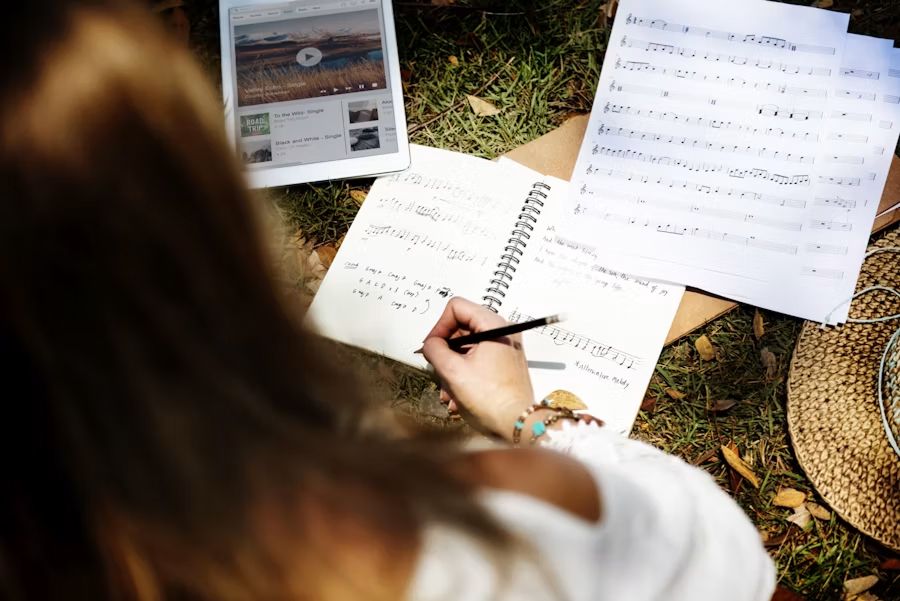
Working out a melody by ear and writing it down: sound first, symbol second
👩🏫🎼 Reading problems are hard to diagnose from the inside: rhythm, key signature and eyes-on-hands all feel the same when a line falls apart. Find a music teacher on MOOZ → and book a lesson in your instrument.
Step 2. The staff, and what a clef actually does
Five lines, four spaces. A note's height on those lines is its pitch: higher on the staff, higher in sound. That part is intuitive.
The clef is the piece people skate past, and it matters more than the mnemonics. A clef fixes one specific line as one specific note, and everything else is measured from that. The treble clef is a stylised letter G, and its curl wraps around the line that is G. The bass clef is a stylised F, and its two dots sit either side of the line that is F. They are not decoration. They are the key to the map.
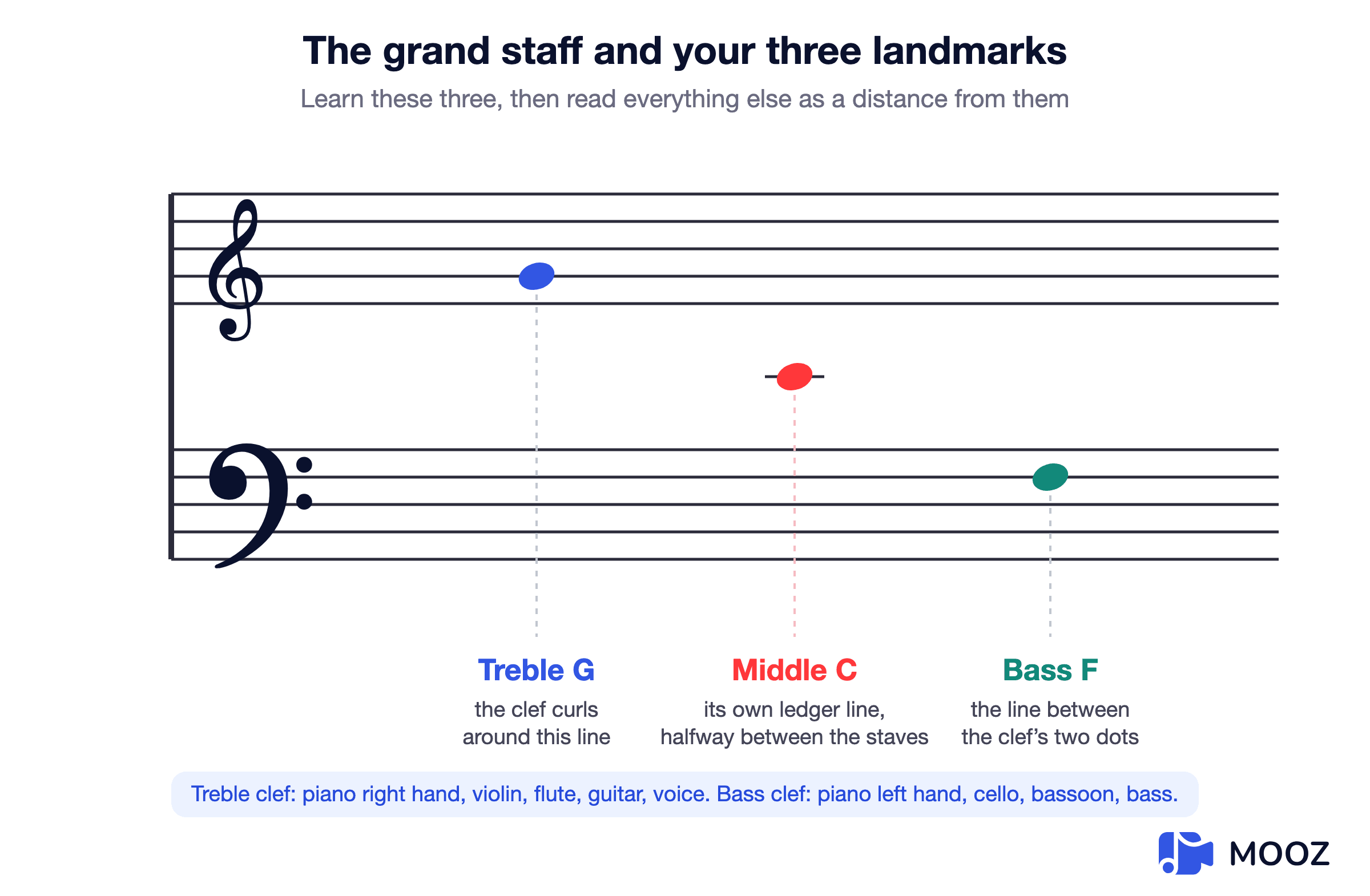
The grand staff and the three landmark notes every beginner should learn first
Which one you read depends on your instrument. Treble clef covers violin, flute, guitar, voice and the piano's right hand. Bass clef covers cello, bassoon, bass guitar and the piano's left hand. Pianists read both at once on a grand staff, which is why piano is the slowest instrument to learn to read on and the best one for understanding how notation works.
Middle C sits between the two staves on its own short ledger line. Ledger lines are just the staff continued past its edges when a note runs off the top or bottom.
If you want every note on both staves named rather than explained, we charted the lot — plus the symbols that sit around them — in music notes and symbols explained. Keep it open in a tab while you work through the steps below.
Step 3. Learn three landmarks, not thirty note names
Here is where most guides send you wrong. They teach the mnemonics — Every Good Boy Does Fine for the lines, FACE for the spaces — and leave you there. Those are useful for checking a note you're unsure of. They are terrible as a reading method, because spelling upward from the bottom line every time is exactly the slow, note-by-note decoding you want to avoid.
The alternative comes from Frances Clark, whose 1955 method Time to Begin reshaped how piano reading is taught in the United States. Clark's approach: learn a few landmark notes cold, then read everything else as a distance from the nearest one. Read by direction and interval, and keep your eyes on the page rather than your hands.
Three landmarks carry a beginner a long way:
- Treble G — second line from the bottom of the treble staff, the line the clef curls around.
- Middle C — its own ledger line between the staves.
- Bass F — the line between the bass clef's two dots.
Then read the distances between notes:
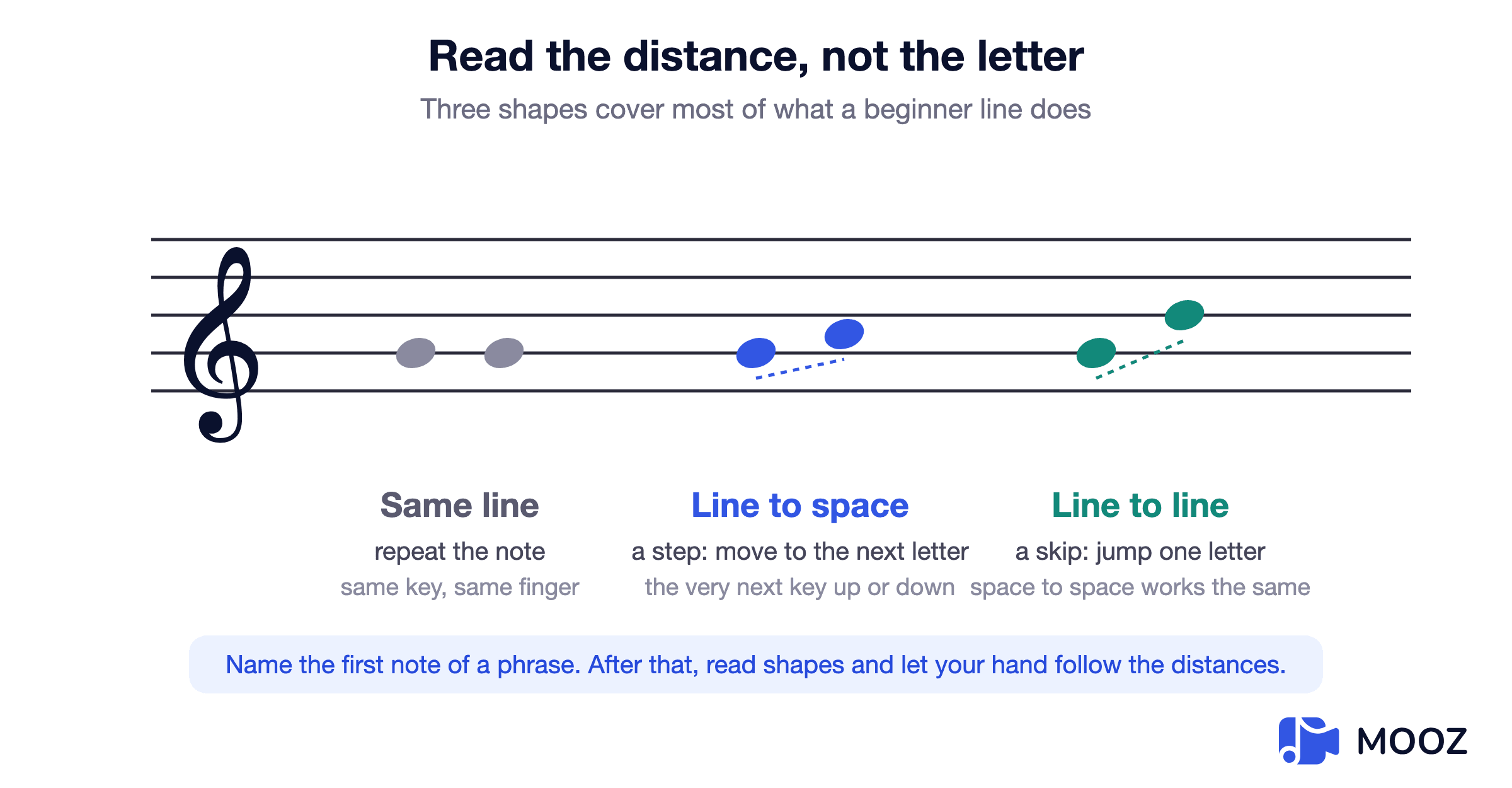
Repeats, steps and skips: read the distance between notes instead of naming every letter
- Same line or same space: repeat the note. Same key, same finger.
- Line to the space next door: a step. Move to the very next letter, the very next key.
- Line to the next line, or space to the next space: a skip. Jump one letter.
So a phrase that climbs line, space, line, space is four steps upward, and you never named a single letter after the first one. This is what fluent readers are doing, and it is learnable from week one.
Step 4. Rhythm is the other half, and it's the half people skip
Pitch tells you which note. Rhythm tells you when, and for how long. When someone says they can't read music, the notes are often fine and the rhythm is guesswork.
The shape of the note tells you its length. Hollow with no stem, hollow with a stem, filled with a stem, filled with a flag: each one is worth half of the one before it.
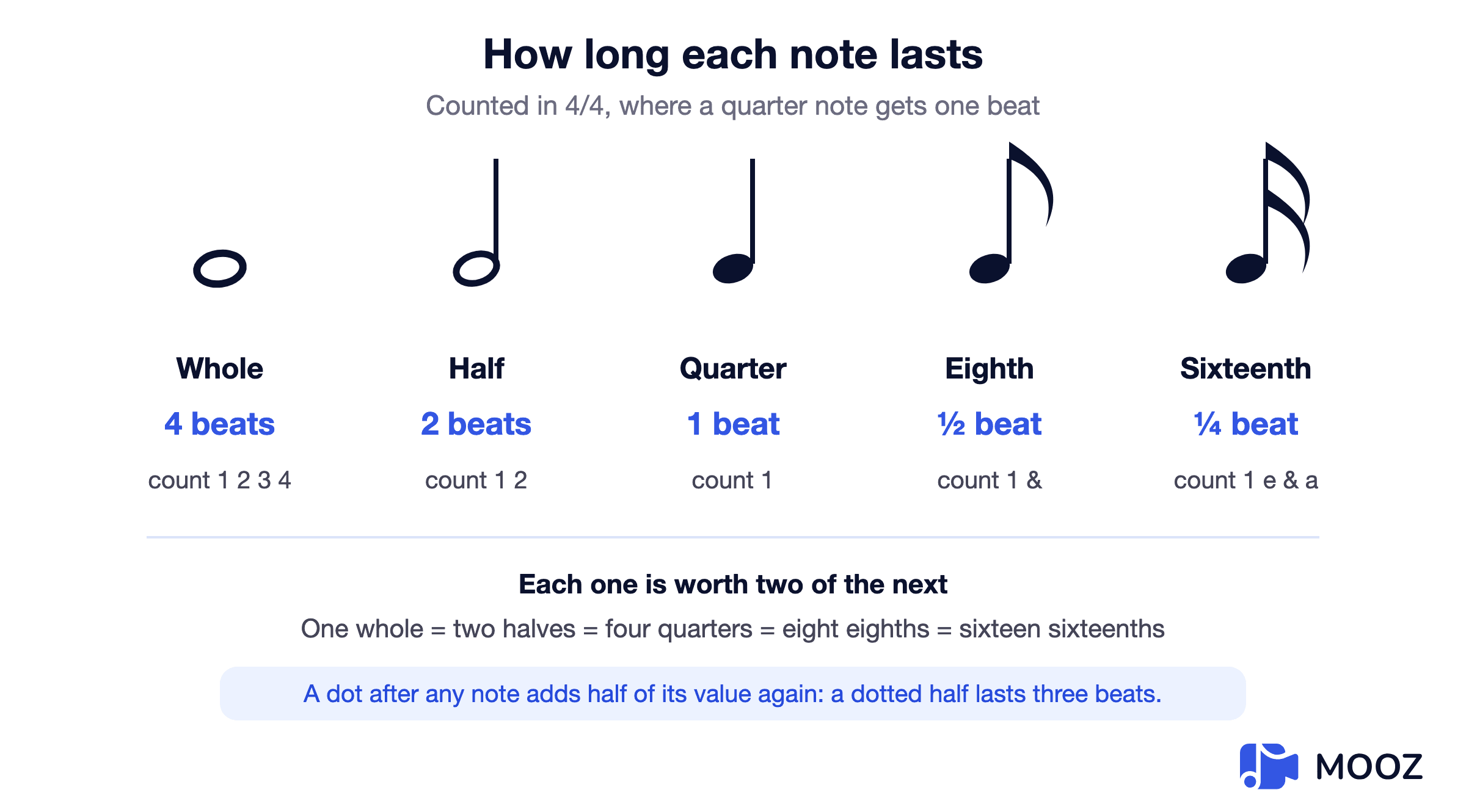
Note values in 4/4, with how to count each one out loud
🎹🎻 Stuck counting out loud, or not sure your rhythm is right? Browse verified music teachers on MOOZ →, filter by instrument and level, and book a trial that fits your schedule.
The two stacked numbers at the start are the time signature. The top number tells you how many beats are in each bar; the bottom tells you which note value gets one beat. In 4/4, the most common by a wide margin, there are four beats per bar and a quarter note gets one of them. In 3/4 you get three, which is a waltz.
A dot after a note adds half its value again, so a dotted half note lasts three beats. A tie joins two notes of the same pitch into one longer sound. Rests are silences with the same values as notes, and they are counted, not skipped.
Count out loud while you play. Not in your head — out loud. It feels ridiculous for about three days and then it is the single most useful thing you do.
Step 5. The key signature, read once and applied all the way down
The sharps or flats sitting between the clef and the time signature are the key signature. They apply to every note of that letter, in every octave, for the whole piece, until something cancels them.
One sharp is G major, two is D, three is A. One flat is F major, two is B flat. You do not need to memorise the whole circle of fifths to start; you need to notice the signature before you play the first note and hold it in mind. Missing it is the most common reading error in the first year, and it produces the specific effect of a piece that sounds almost right and slightly sour.
An accidental — a sharp, flat or natural written in front of a note mid-piece — applies only to that note for the rest of that bar, then expires.
Step 6. Everything else on the page
The rest of the marks are instructions about how, not what. You can ignore most of them on day one and add them as you go:
- Dynamics. p is quiet, f is loud, mp and mf are the moderate versions. Hairpins that open or close mean get gradually louder or quieter.
- Articulation. A dot above a note means short and detached. A curved line joining different pitches is a slur: play them smoothly, and on wind and string instruments it means one breath or one bow.
- Tempo. Words at the top like Andante or Allegro, or a metronome mark like ♩= 90.
- Repeats. Double bars with dots mean go back and play it again. D.C. sends you to the beginning, D.S. to a marked sign, and a coda is the ending you jump to.
- 8va. Play an octave higher than written, used to avoid stacks of ledger lines.
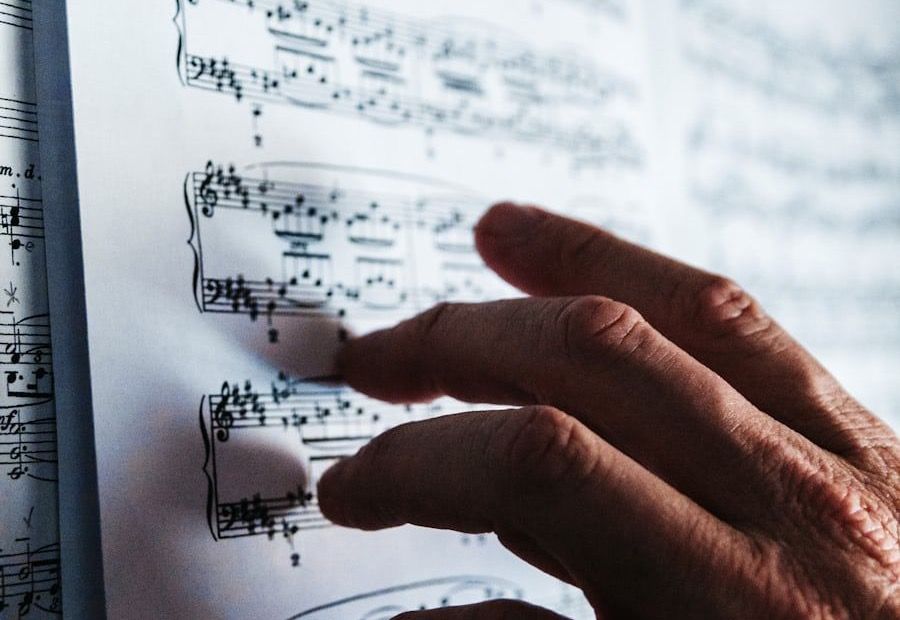
Fluent readers are already a bar or two ahead of the note their hands are playing
Step 7. Read ahead. This is where speed actually comes from
In 1974 the psychologist John Sloboda measured what happens when musicians sight-read by stopping them mid-performance and asking how much they could still see. Skilled readers were taking in around 6.8 notes beyond where their hands were. Less skilled readers managed about 3.8. The good ones were always reading the future while playing the present.
For decades that was treated as a symptom of talent. A 2019 study in Scientific Reports, following 30 professional pianists, sharpened the picture: skilled sight-readers don't hold one permanently long span. They stretch and shrink it depending on how hard the passage is. Reading ahead is a strategy, not a gift, which means you can practise it deliberately.
How to practise it:
- Play music that is genuinely too easy. You cannot look ahead if the notes under your hands need all your attention.
- Keep going when you make a mistake. Stopping to fix a wrong note trains your eyes to sit still, which is the opposite of the goal.
- Have someone cover the bar you're playing, or use a card that slides along just behind your hands.
- Look at the page, not your hands. This is Clark's point from step 3, and on piano it is most of the battle.
Step 8. A fifteen-minute daily routine
Short and daily beats long and occasional, because reading is pattern recognition and patterns need repeated exposure more than they need long sessions.
- 3 minutes, rhythm only. Clap and count a line out loud. No instrument.
- 3 minutes, landmarks. Point at notes at random and name them out loud. Still no instrument. Time yourself and try to beat yesterday.
- 5 minutes, sight-read something new. Something easy you have never seen. Play it once, badly, without stopping. Then leave it and pick a different piece tomorrow.
- 4 minutes, eyes on the page. Play a line you already know while looking only at the music.
Fifteen minutes, and only five of them involve music you can't already handle. That ratio is deliberate.
How long does this actually take?
The basics — staff, clefs, landmarks, note values, time and key signatures — take most adults two to four weeks of short daily practice to stop feeling foreign.
Fluent sight-reading is a longer road, measured in months and years, and it is a genuinely separate skill from playing well. Plenty of accomplished musicians read slowly. Plenty of mediocre players sight-read beautifully. If your reading feels far behind your playing, nothing is wrong with you; you have simply practised one and not the other.
Six mistakes that keep beginners slow
- Writing letter names under the notes. It gets you through this week's piece and teaches you to read the letters, not the notation. If you must, do it in pencil and rub it out once you can play the line.
- Spelling every note from the bottom line up. Fine as an occasional check, fatal as a method.
- Learning pitches without rhythm. Half the information on the page is duration.
- Only reading music you already know by ear. Your ear does the work and your eyes coast.
- Watching your hands. Every glance down costs you your place.
- Practising material that is too hard. Reading practice happens at a level where you can keep going.
Where to go next, by instrument
Reading is the same system everywhere, but the first month looks different depending on what you play.
- Piano. Two clefs at once, which is harder at the start and pays off later. If you're starting from scratch, our step-by-step guide to teaching yourself piano covers the practical setup, and how many keys are on a piano explains how the keyboard maps onto the staff.
- Guitar. Most guitarists start with tab, which tells you where to put your fingers but nothing about rhythm or pitch. Our easy guitar tabs for beginners is a good place to start playing; standard notation is what you'll want when you move beyond riffs.
- Violin. Treble clef only, and the notes-to-fingers map is the thing to learn first. We covered it in violin notes for beginners.
FAQ: reading sheet music basics
What are the basics of reading sheet music?
Five things: the staff and what the clef fixes on it, a few landmark notes, reading by step and skip rather than by letter, note values and the time signature, and the key signature. Everything else is detail you can add once those five are automatic.
How can I read music if I've never played an instrument?
You can, and it's a reasonable way to start. Clap rhythms, sing lines with solfège or letter names, and learn the landmarks on paper. Kodály's whole approach assumes musical literacy comes before instrumental technique, not after it.
How long does it take to learn to read sheet music?
Two to four weeks of daily ten-minute practice to read simple music without stalling on every note. Fluent sight-reading of unfamiliar music takes considerably longer and improves for as long as you keep doing it.
What's the fastest way to learn to read notes on sheet music?
Landmarks plus intervals, practised on music that is too easy for you, every day, out loud. Speed comes from reading ahead, and you can only read ahead when the notes under your hands aren't demanding all of your attention.
Do I need to read music to play an instrument?
No. Many excellent musicians play by ear, from tab, or from chord charts. Reading widens what you can access on your own: anything ever written down, without waiting for someone to make a tutorial of it.
Is it harder to learn to read music as an adult?
Different, not harder. Adults grasp the logic of the system much faster than children do. What adults find harder is the patience for material that feels beneath them, which is exactly the material that builds reading speed.
Should I use an app to learn to read music?
Note-naming apps are good for the landmark drill in step 8 and useless for the rest. They test recognition of single notes in isolation, which is not what reading is. Use them for three minutes a day, then read actual music.
Getting it checked by someone who reads well
Reading is one of the few parts of learning music where you genuinely can make progress alone. A book, a metronome and fifteen minutes a day will move you forward.
What a teacher changes is the diagnosis. When a line falls apart, the cause might be the rhythm, the key signature, a bad fingering choice, or eyes glued to the hands — and those four problems feel identical from the inside. Someone watching for ten minutes will tell you which one it is, and that saves weeks of practising around a problem instead of through it.

Browse verified music teachers on MOOZ and filter by instrument
On MOOZ you can browse verified music teachers by instrument, filter by level, language and price, and book a lesson directly. Lessons run in a platform built for music rather than a general video call, so the sound isn't compressed into mush and your teacher can actually see the page and your hands at the same time.
Sources
- Zoltán Kodály, The Selected Writings of Zoltán Kodály (Boosey & Hawkes, 1974), p. 196; the passage dates from 1953.
- Edwin E. Gordon, "All About Audiation and Music Aptitudes," Music Educators Journal 86, no. 2 (September 1999): 41–44.
- Frances Clark, Time to Begin (1955), the method that introduced intervallic reading and landmark notes to piano pedagogy.
- John Sloboda, "The Eye-Hand Span: An Approach to the Study of Sight Reading," Psychology of Music 2, no. 2 (1974): 4–10.
- Lim et al., "Eye-Hand Span Is Not an Indicator of but a Strategy for Proficient Sight-Reading in Piano Performance," Scientific Reports (2019).
Related Articles

Synchronization in Online Music Lessons: A Complete Breakdown
Learn how tech fixes internet latency. Make synchronous music today!
How to Start Your First Lesson in MOOZ: A Step-by-Step Guide
Read MOOZ step-by-step guide to make your first class smooth, professional, and perfectly in tune.

Guide to Teach Music Online Smarter: MOOZ & Moosiko Insights
Learn how to solve the 5 biggest online teaching challenges that are costing you time and students.