
Lesson Lab
A page of music is a grid with a key attached. The grid is the staff, always five lines. The key is the clef, and until you know which clef you're looking at, not a single note on that page has a name.
That's the whole trick, and it's why this guide is organised around the two clefs you'll actually meet. Below you'll find every note on the treble staff, every note on the bass staff, how the two join into the grand staff, what ledger lines do at the edges, and the symbols that sit around the notes telling you how to play them.
This is the reference. If you want the method for getting fast at reading, that's a different job and we covered it in how to read sheet music, step by step.
The staff, and why the clef comes first
Five lines, four spaces between them. A note sits either on a line or in a space, and the higher it sits, the higher it sounds. Two notes on the same line are the same pitch.
What the staff doesn't tell you is which pitches. Five lines could mean almost anything, and that's the clef's job: it nails one specific line to one specific note, and every other note is counted out from there in alphabet order. Music uses seven letters, A to G, and then starts over.
Change the clef and every note on the page changes name without a single dot moving. This is why the same five lines can serve a piccolo and a double bass.
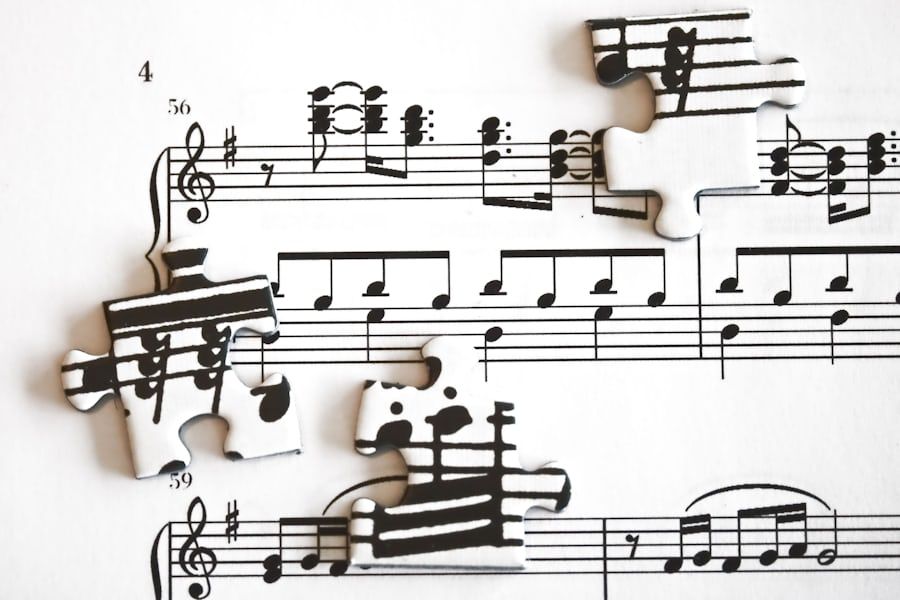
Notation is a small set of pieces that always fit together the same way
👩🏫🎼 Charts teach facts. Habits — like reading a key signature before the first note — need someone watching. Get MOOZ and take your first music lesson →.
Treble clef: the notes
The treble clef is a decorated letter G, which is why it's also called the G clef. Look at where the curl spirals: it wraps around the second line from the bottom, and it is telling you that this line is G — specifically the G above middle C.
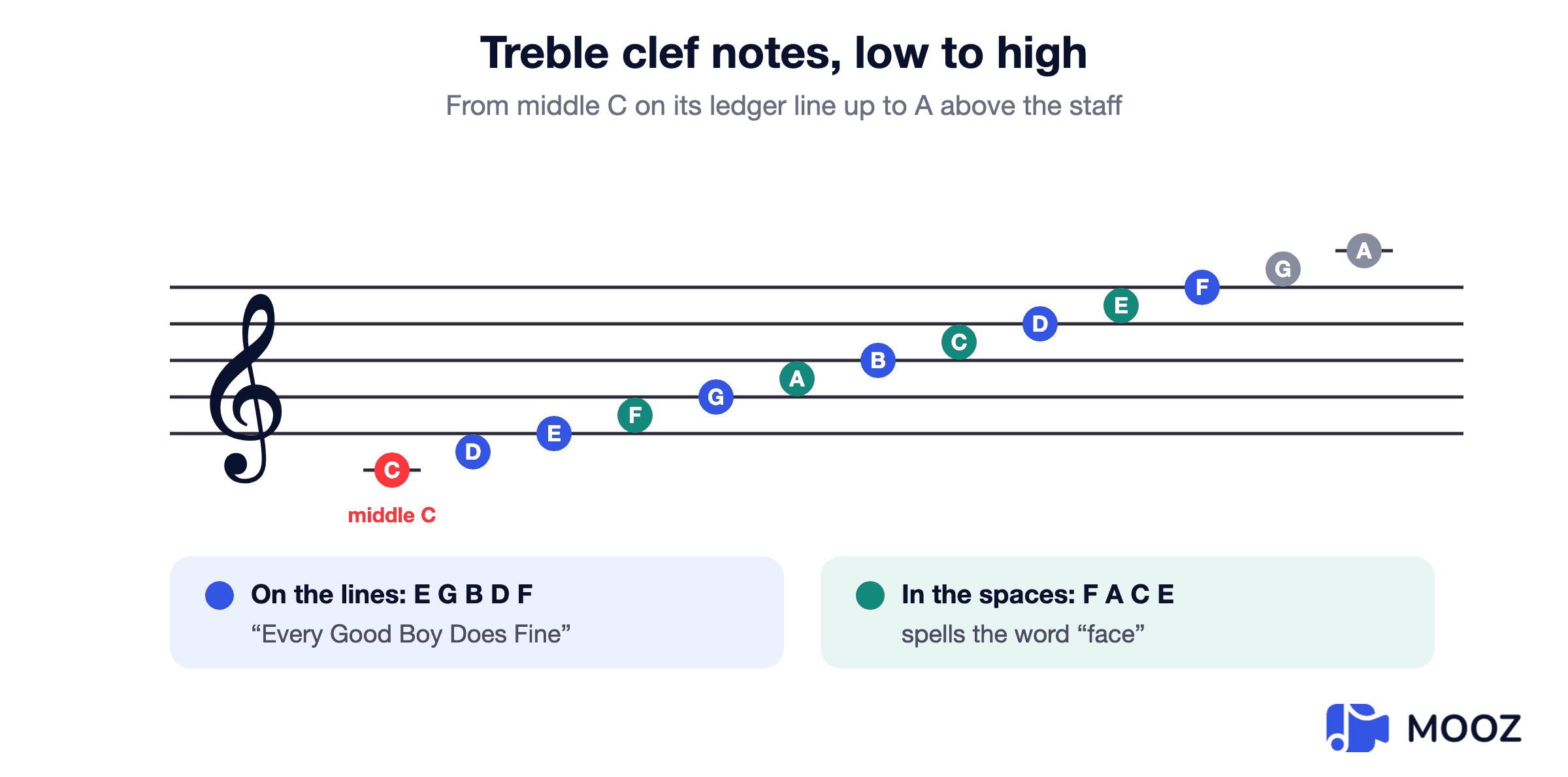
Treble clef notes: lines E G B D F, spaces F A C E, middle C on a ledger line below
Read from the bottom up:
- Notes on the lines: E, G, B, D, F. The old mnemonic is Every Good Boy Does Fine.
- Notes in the spaces: F, A, C, E, which conveniently spells a word.
Below the bottom line the alphabet keeps going down: the space under the staff is D, and the note below that is middle C, sitting on its own short ledger line. Above the top line, the space is G, then A on a ledger line above.
Treble clef is read by violin, flute, oboe, clarinet, trumpet, saxophone, guitar and voice, plus the right hand of the piano. It is far and away the most common clef, which is why "treble clef notes" is the thing most beginners look up first.
Bass clef: the notes
The bass clef is a stylised letter F, so it's also called the F clef. It has two dots, and they aren't decorative either: they sit either side of the fourth line from the bottom, and that line is F — the F below middle C.
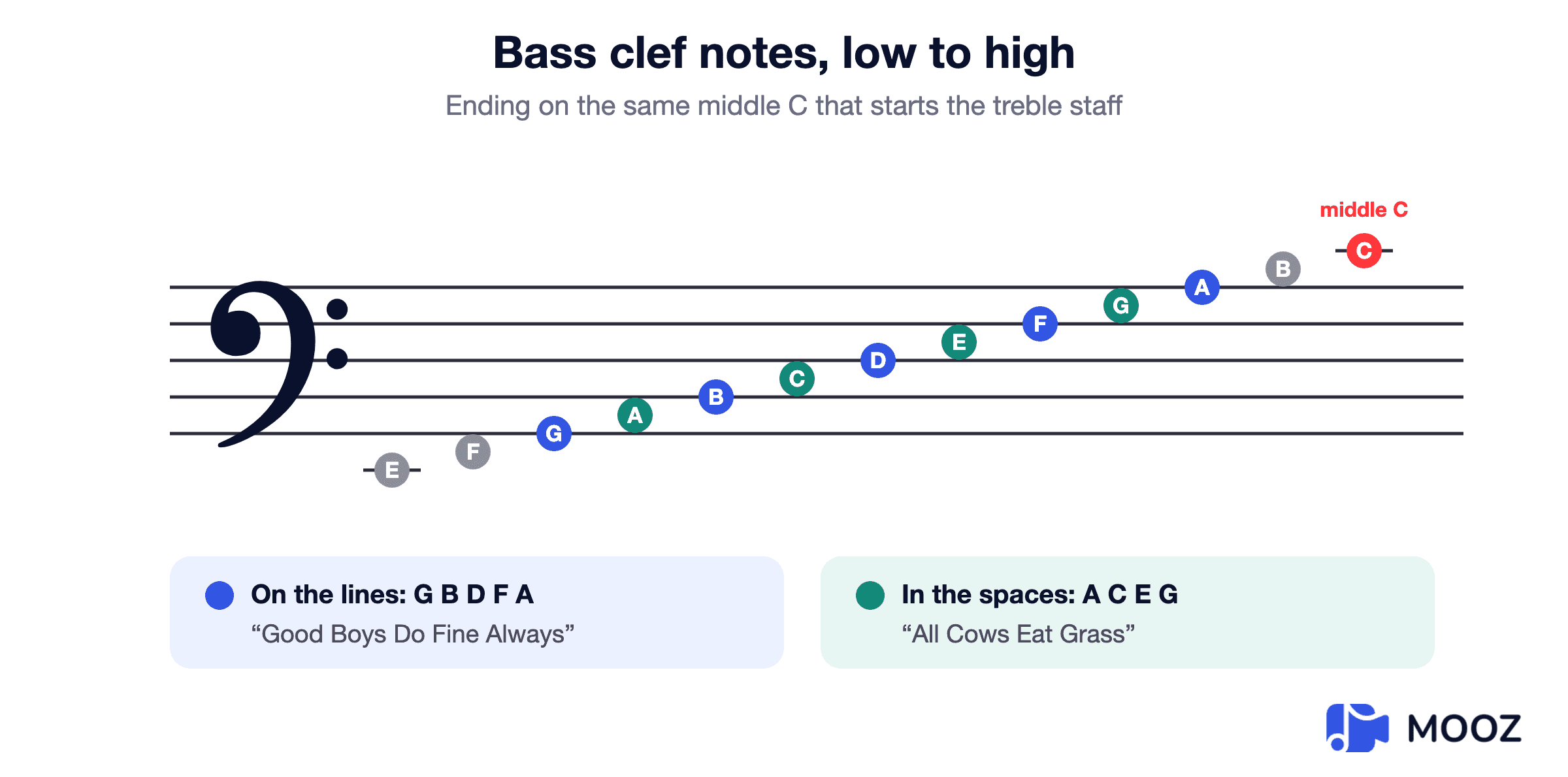
Bass clef notes on the staff: lines G B D F A, spaces A C E G, middle C on a ledger line above
Same reading, bottom up, but everything has shifted:
- Notes on the lines: G, B, D, F, A. Good Boys Do Fine Always.
- Notes in the spaces: A, C, E, G. All Cows Eat Grass.
Below the bottom line, the space is F and the next note down is E on a ledger line. Above the top line, the space is B, and one ledger line above sits middle C again.
Bass clef is read by cello, double bass, bassoon, trombone, tuba, bass guitar, and the piano's left hand.
The thing that trips people up: no note keeps its position between the two clefs. The bottom line is E in treble and G in bass. If you learned one clef first, your instinct on the other will be wrong every single time until you retrain it, and that is normal rather than a sign you've misunderstood something.
The grand staff, and the note that joins it
Piano, harp and organ music uses both staves at once, braced together at the left edge. That pairing is the grand staff.
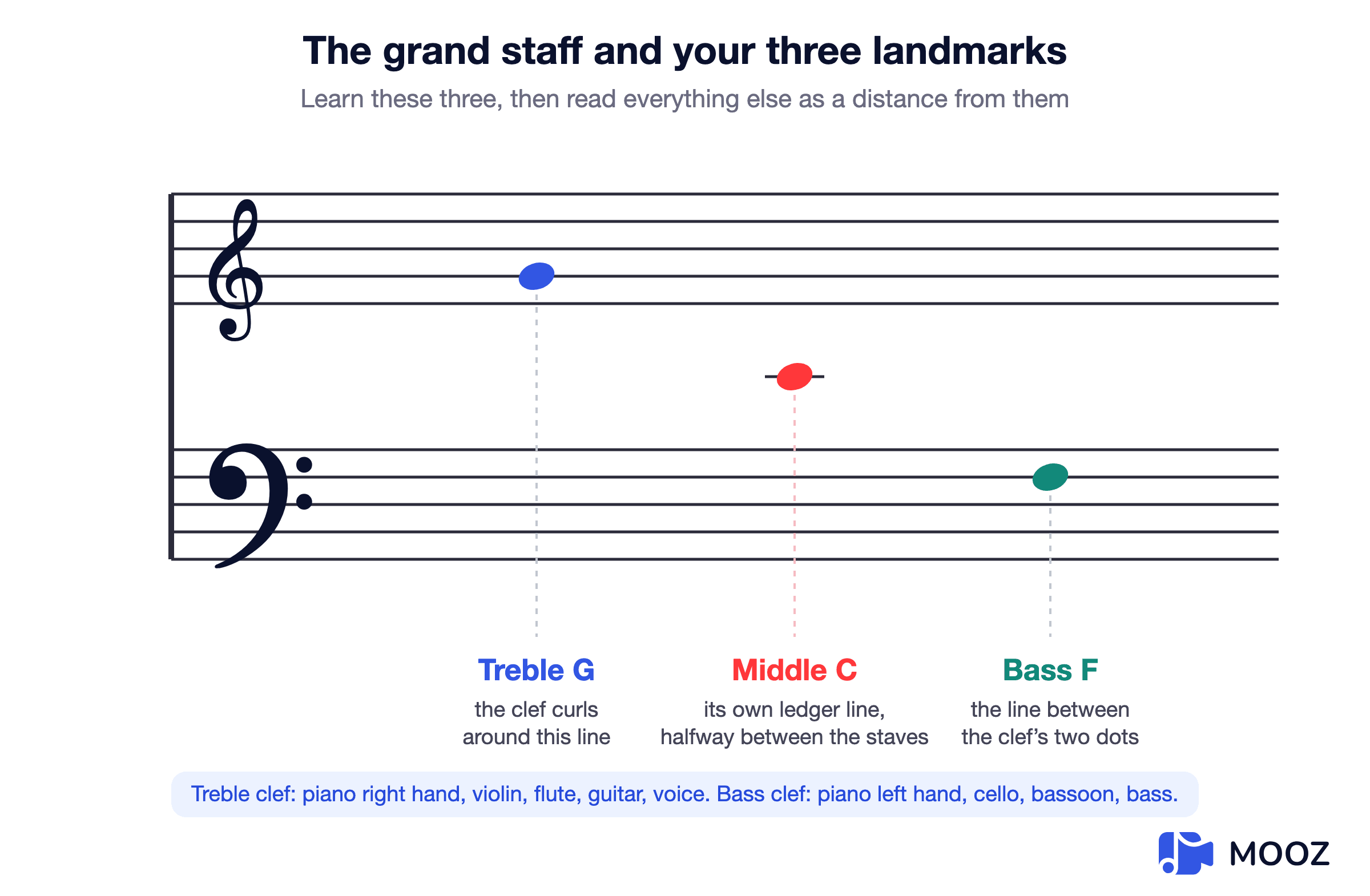
The grand staff: two staves joined, with middle C sitting in the gap between them
The two staves are not separate systems. They're one continuous ladder of pitch with a gap in the middle, and exactly one note lives in that gap: middle C. Look at the two charts above and you'll see it appear twice — one ledger line below the treble staff, one ledger line above the bass staff. Same key on the piano, same pitch, written in whichever staff the music needs it.
Middle C is the most useful landmark in all of notation, because it's the hinge. Everything above it climbs through the treble staff, everything below it descends through the bass staff, and if you can find it on your instrument you can work out anything near it by counting.
Ledger lines
Ledger lines are the staff continued past its own edges: short strokes added above or below to carry notes that ran out of room.
Three things worth knowing:
- They follow the same alternation. Line, space, line, space, without interruption. The first ledger line below the treble staff is middle C, the space below it is B, the second ledger line is A.
- Count from the staff, not from the middle. Find the nearest line you know and step outward. Counting the whole alphabet from middle C every time is how ledger notes stay slow forever.
- Beyond about three, composers give up. Rather than stack five ledger lines, they write the note lower and add 8va above it, meaning play an octave higher than written. Below the staff, 8vb means play an octave lower.
Other clefs you might meet
Two more exist, and both are C clefs: whatever line the middle of the symbol points at becomes middle C.
- Alto clef. Middle C on the centre line. This is viola's clef, and violists read it almost exclusively.
- Tenor clef. Middle C on the fourth line. Cello, bassoon and trombone switch into it for high passages so the music doesn't disappear into ledger lines.
If you don't play those instruments, you can safely ignore both. If you do, notice the logic is identical: the clef points at a note, and the rest is counting.
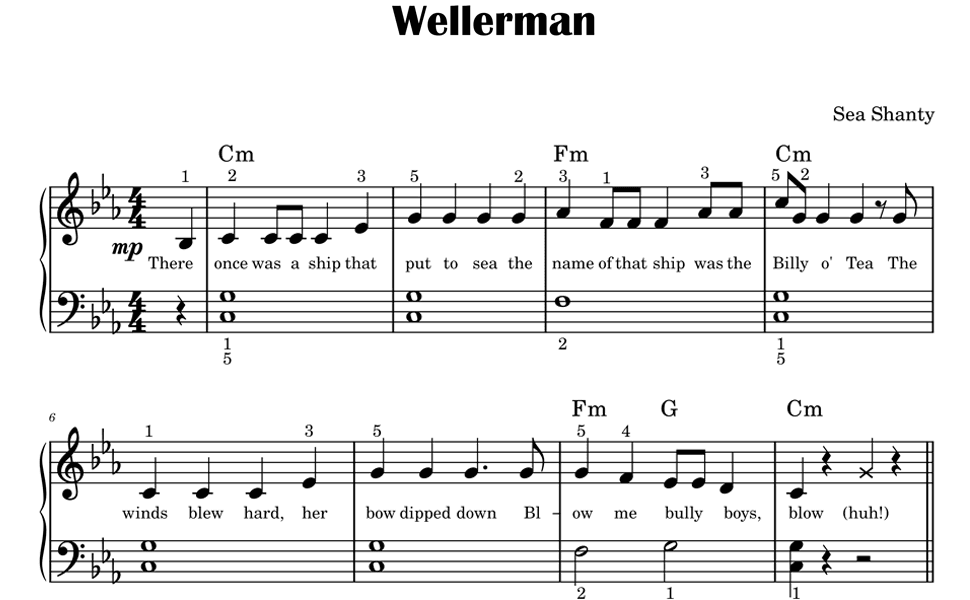
Real music, with most of these symbols on the page at once
Music notation symbols, grouped by what they do
Everything else on the page is answering one of five questions: which pitch, how long, how loud, how played, or where to go next.
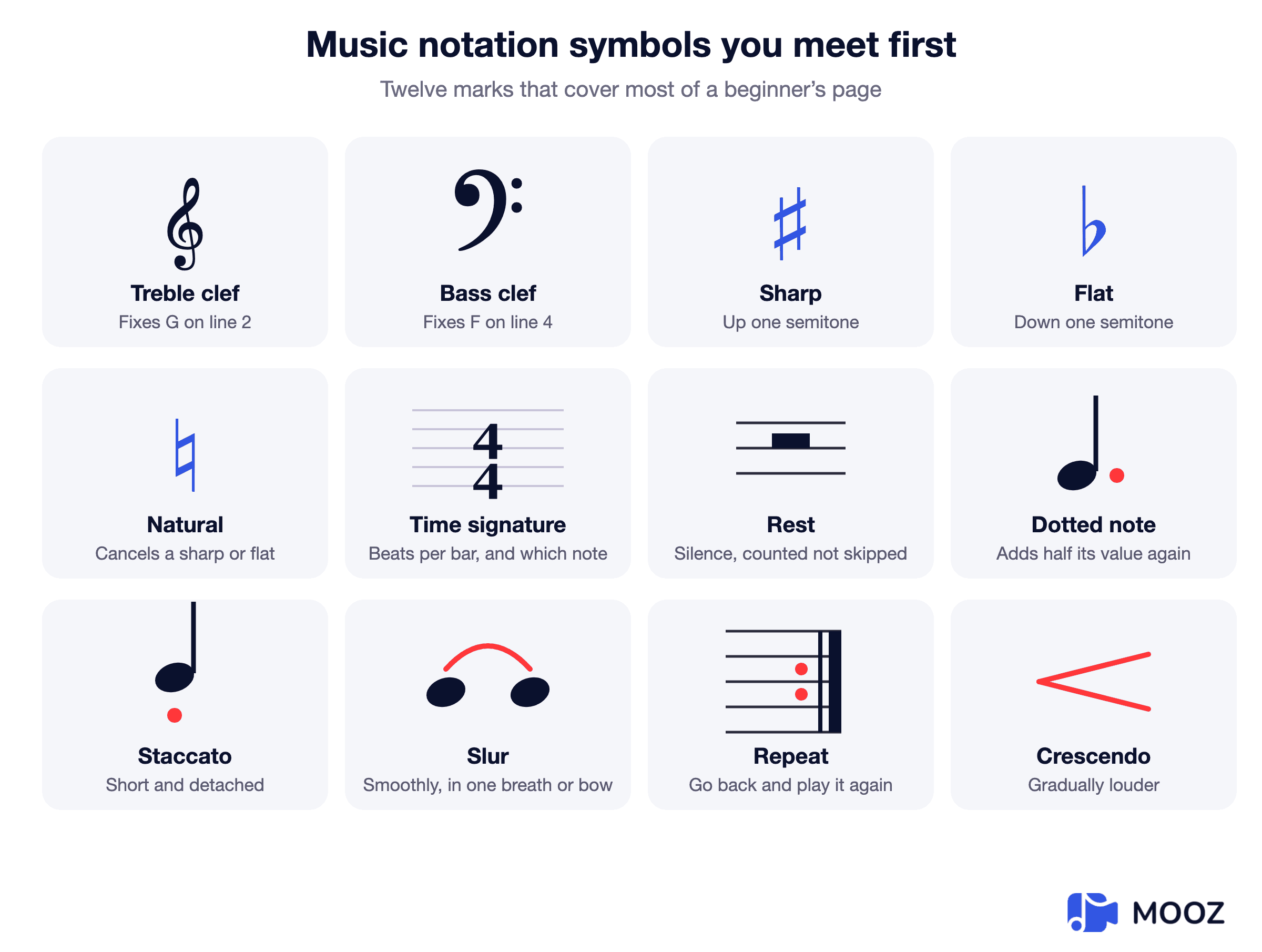
Twelve music notation symbols that cover most of a beginner's page
Pitch changers
- Sharp (♯) raises a note by a semitone, flat (♭) lowers it by one, and natural (♮) cancels either.
- Written at the start of the line, next to the clef, they form the key signature and apply to every note of that letter, in every octave, for the whole piece.
- Written in front of a single note mid-bar, they're accidentals, and they expire at the end of that bar.
- Double sharps (𝄪) and double flats (♭♭) exist and move a note by two semitones. You'll meet them eventually, not soon.
Duration
- Note values. Whole, half, quarter, eighth, sixteenth. Each is worth two of the next one down.
- A dot after any note adds half its value again: a dotted half note lasts three beats instead of two.
- A tie joins two notes of the same pitch into one longer sound. Play it once, hold it through both.
- Rests are measured silences, with values matching the notes. They are counted, not ignored, and this is where a lot of beginner rhythm falls apart.
Time
- The time signature is two stacked numbers after the clef. Top: how many beats per bar. Bottom: which note value gets one beat. In 4/4 there are four beats and a quarter note gets one.
- Bar lines divide the music into bars. A double bar line marks a section end; a thick double bar means the piece is over.
Loudness
- p (quiet), f (loud), mp and mf for the moderate versions, pp and ff for the extremes.
- Hairpins — long thin wedges — mean get gradually louder (crescendo) or quieter (diminuendo).
How to play it
- Staccato is a dot above or below the notehead: short and detached.
- Accent is a small wedge: lean on that note.
- A slur is a curved line over different pitches: play them smoothly, and on wind and string instruments it means one breath or one bow. It looks like a tie but does a different job.
- A fermata looks like an eyebrow with a dot: hold the note longer than written, for as long as feels right.
Where to go next
- Repeat signs are double bars with two dots. Play the section again.
- First and second endings are numbered brackets: play the first ending, repeat, then skip to the second.
- D.C. sends you back to the beginning; D.S. back to a marked sign (the segno); coda marks the tail you jump to at the end.
Quick reference: every note, both clefs
This is the part worth screenshotting. Colour tells you where a note sits before you read a word of it: blue on a line, green in a space, grey outside the staff altogether. Middle C is marked in red in both panels, because it is the same note written two different ways.
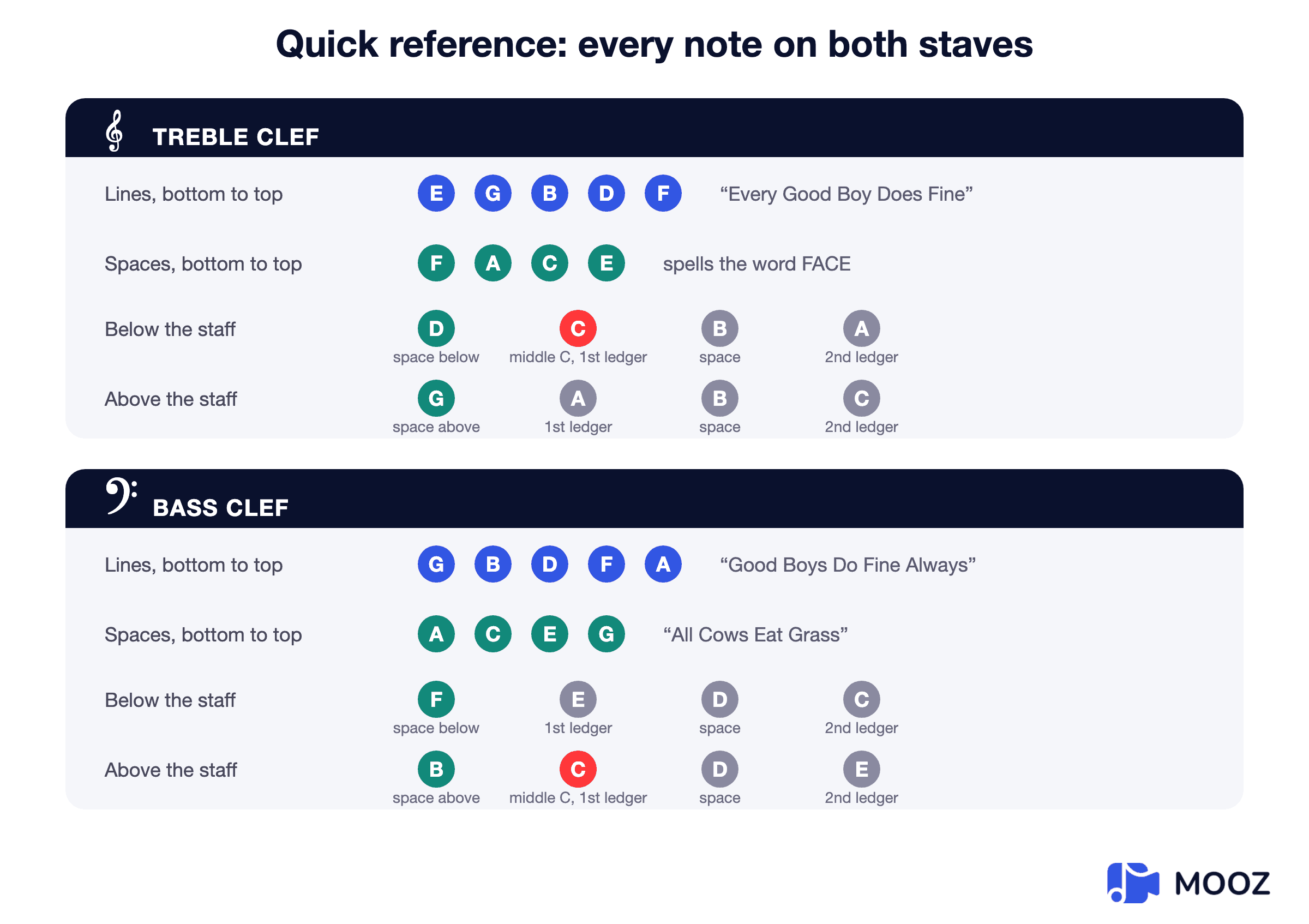
Every note on both staves: lines, spaces, and what happens past the edges
Learning them without the mnemonics
The mnemonics are training wheels, and they have a cost: spelling Every Good Boy Does Fine from the bottom line every time you meet a note is exactly the habit that keeps reading slow.
Use them to check yourself, not to read. What fast readers do instead is hold three or four notes in memory — treble G, middle C, bass F — and read every other note as a distance from the nearest one. Five minutes a day of naming notes out loud, without an instrument, moves this faster than anything else.
The full method, including how to practise reading ahead, is in how to read sheet music, step by step. If you play a specific instrument, the mapping from page to hand is the next thing to learn: we have it for violin, and the piano keyboard layout guide shows how the grand staff lines up with the keys under your hands.
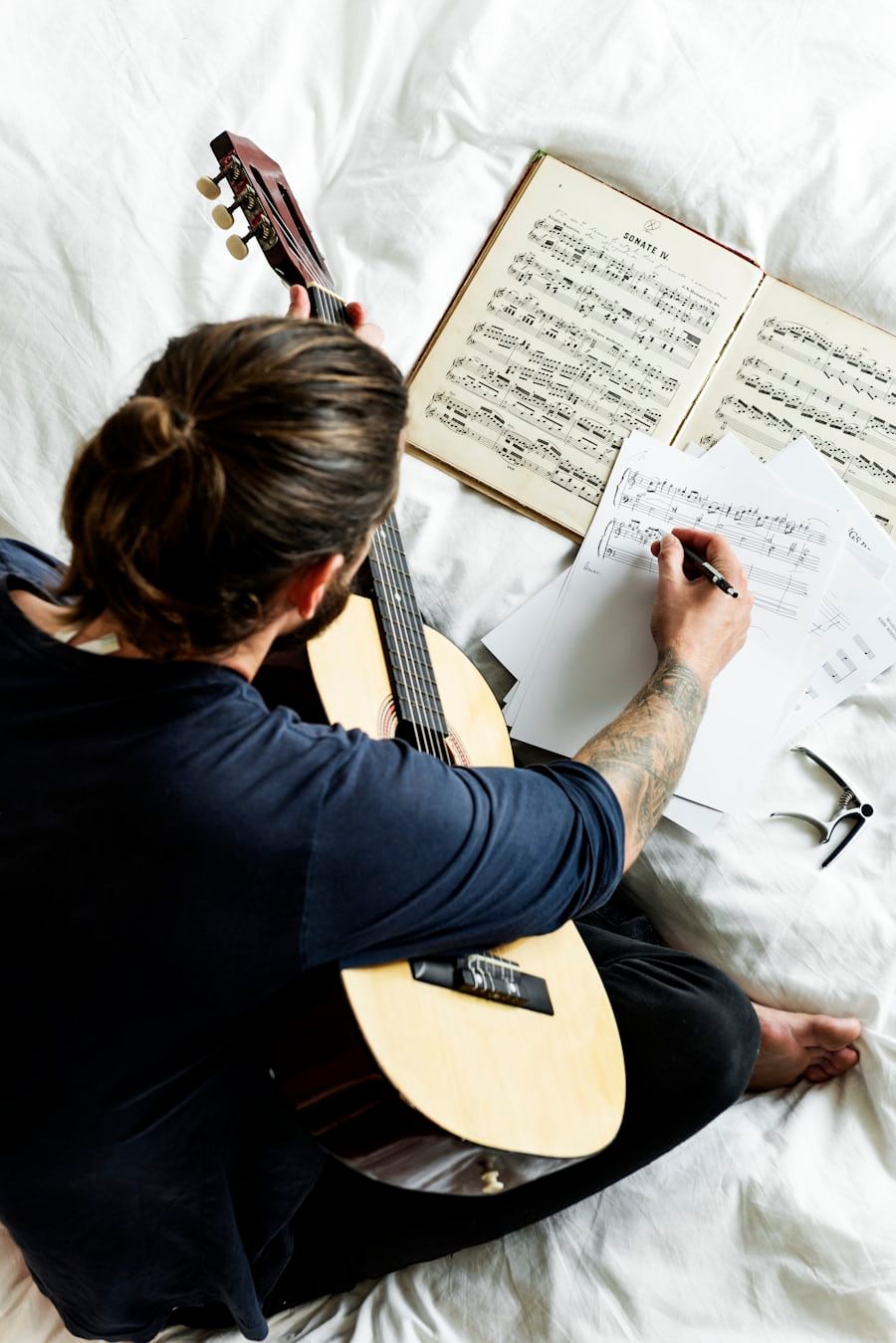
Naming notes on paper, away from the instrument, is what makes them automatic
FAQ: notes and symbols
What is the treble clef?
The clef that fixes G above middle C on the second line from the bottom of the staff. It's a decorated letter G, and it's used by most instruments that play in a higher range, along with the piano's right hand.
What are the bass clef notes on the staff?
On the lines, bottom to top: G, B, D, F, A. In the spaces: A, C, E, G. The clef's two dots straddle the F line, which is the fourth line up.
Why do the same lines mean different notes in each clef?
Because the clef is what assigns the letters, and the two clefs cover different ranges. Between them they span most of what a piano can play without heaps of ledger lines.
What is the grand staff?
Treble and bass staves braced together and read at the same time, used for piano, harp and organ. Middle C sits in the gap between them and can be written in either staff.
What are ledger lines?
Short added lines that extend the staff for notes too high or too low to fit. They continue the same line-space alternation. Past about three of them, music switches to an 8va or 8vb marking instead.
Do I need to learn both clefs?
Only pianists, organists and harpists need both from the start. Everyone else learns the clef their instrument uses, and picks the other one up later if they start accompanying, arranging or reading scores.
What's the difference between a tie and a slur?
A tie connects two notes of the same pitch and makes them one longer note. A slur connects different pitches and means play them smoothly. Same curve, different meaning, decided entirely by whether the pitches match.
What are the most common music notation symbols?
Clefs, sharps and flats, the time signature, note values and rests, dots and ties, dynamic marks, slurs and staccato dots, and repeat signs. That set covers nearly all beginner sheet music.
When a chart isn't enough
Charts are good at facts and bad at habits. Nothing on this page will tell you that you're counting a dotted rhythm wrong, that you've been ignoring the key signature for three weeks, or that you learned middle C in the wrong octave and have been quietly transposing everything since.
Those are the errors that survive self-teaching, because they're invisible from the inside. Ten minutes with someone watching you read is usually enough to catch all three.

Browse verified music teachers on MOOZ and filter by instrument
On MOOZ you can get MOOZ and take your first music lesson. Lessons run in a platform built for music, so your teacher can see the page and your hands at once and hear what you're actually playing.
Related Articles

Before & After: MOOZ Multi-Cam Boosts Online Guitar Classes
Learn how MOOZ Multi-Cam system dramatically elevates online guitar lessons.
The First 30 Days: How to Check Your Online Music Lessons Work
Read MOOZ's step-by-step guide to checking your online music lessons after the first month.
Music Teachers and Time Management: Burnout Cancelled
Drowning in lesson plans and admin? This guide helps music teachers master their schedule.