
Lesson Lab
A standard piano has 88 keys — 52 white keys for the natural notes (A through G) and 36 black keys for sharps and flats. This layout spans just over seven octaves plus a minor third, from the lowest A to the highest C. The repeating pattern of black keys in groups of two and three makes it easy to orient yourself and find any note quickly. Whether you're sitting at an acoustic grand, an upright, or a digital piano, understanding this keyboard layout is the essential first step to playing confidently.
Why Do Pianos Have 88 Keys? A Quick History with Clarity
Early pianos invented by Bartolomeo Cristofori in the 1700s had far fewer keys — often around 49 to 54. As composers like Mozart, Beethoven, Chopin, and Liszt pushed musical boundaries, manufacturers expanded the range to allow richer bass notes and brighter high notes.
By the late 1880s, Steinway & Sons standardized the modern 88-key piano. This design stuck because it covers virtually all music written for the instrument — from classical masterpieces to today's pop and jazz — while staying practical for human hearing and manufacturing. Adding more keys beyond this point produces notes that become either rumbling noise in the bass or piercing, less musical tones in the extreme treble.
Most full-size acoustic and digital pianos in 2026 still follow this 88-key standard. Smaller keyboards (61 or 76 keys) exist for portability or beginners on a budget, but serious students benefit from starting on a full 88-key instrument to avoid relearning the "geography" of the keyboard later.
Once you know your way around the keys, the next wall is the page. Our step-by-step guide to how to read sheet music covers the staff, both clefs, and how the grand staff lines up with the keyboard you're looking at here.
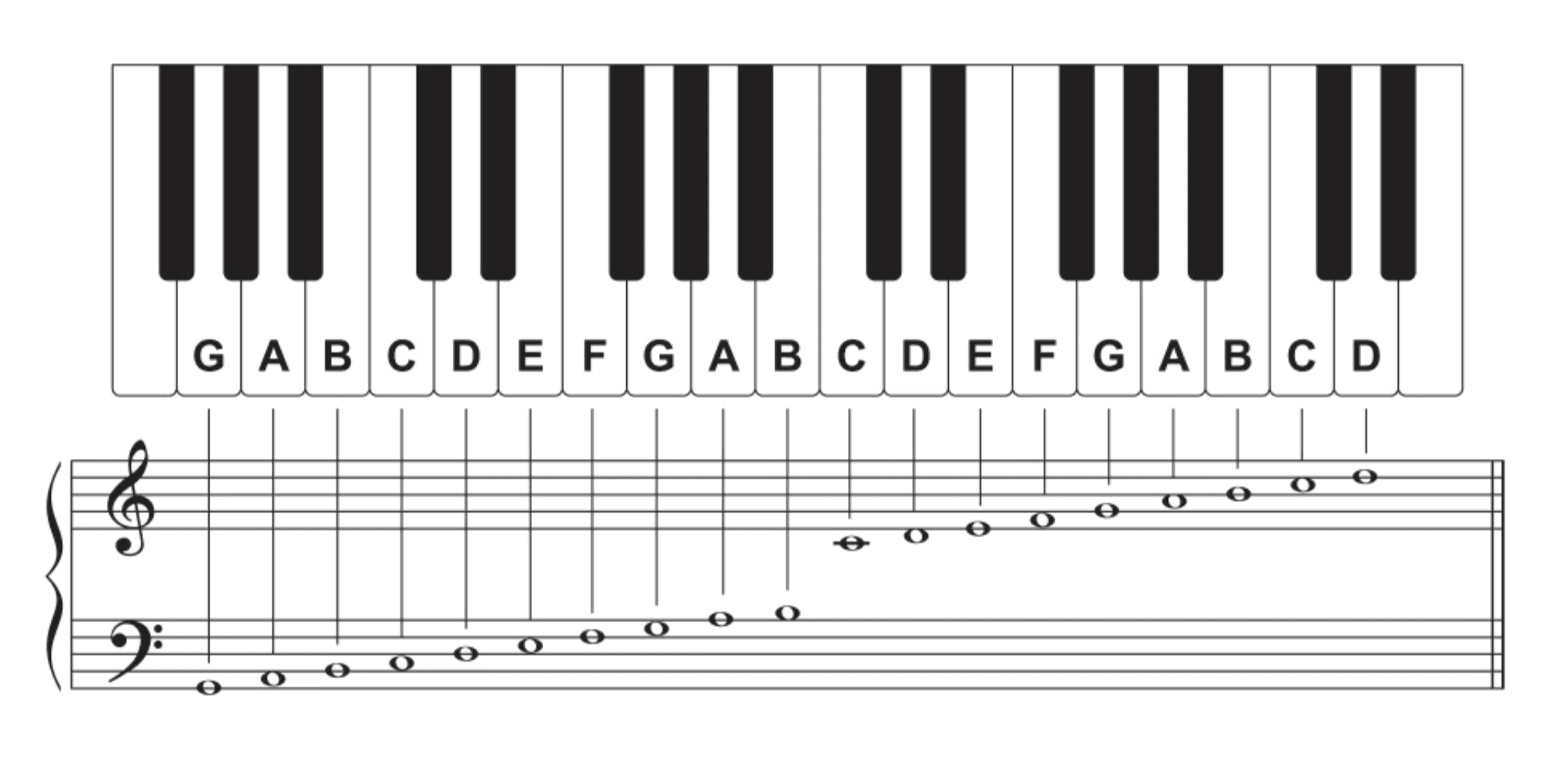
Full 88-Key Piano Keyboard Layout Diagram
Breaking Down the Piano Keyboard Layout: White Keys, Black Keys, and the Repeating Pattern
The piano keyboard follows a simple, repeating structure that makes it much easier to learn than it first appears.
-
White keys: There are 52 white keys. They represent the seven natural notes of the musical alphabet: A, B, C, D, E, F, G. These repeat across the keyboard in every octave.
-
Black keys: There are 36 black keys. They represent the sharps (#) and flats (♭) — the notes "in between" the white keys. Each black key actually has two names (for example, the black key between C and D is both C-sharp and D-flat).
The magic lies in the pattern of black keys: They appear in repeating groups of two black keys followed by three black keys.
This pattern repeats across the entire keyboard and serves as your best navigation tool:
- Find any group of two black keys. The white key immediately to the left of that group is always C.
- Find any group of three black keys. The white key immediately to the left of that group is F.
Middle C — the most important reference note for beginners — sits roughly in the center of the keyboard, just left of the two-black-key group nearest the middle.
Each full octave contains 12 keys total: 7 white + 5 black. On an 88-key piano, you get exactly 7 full octaves plus a few extra notes at the bottom (starting on A instead of C) and the top.
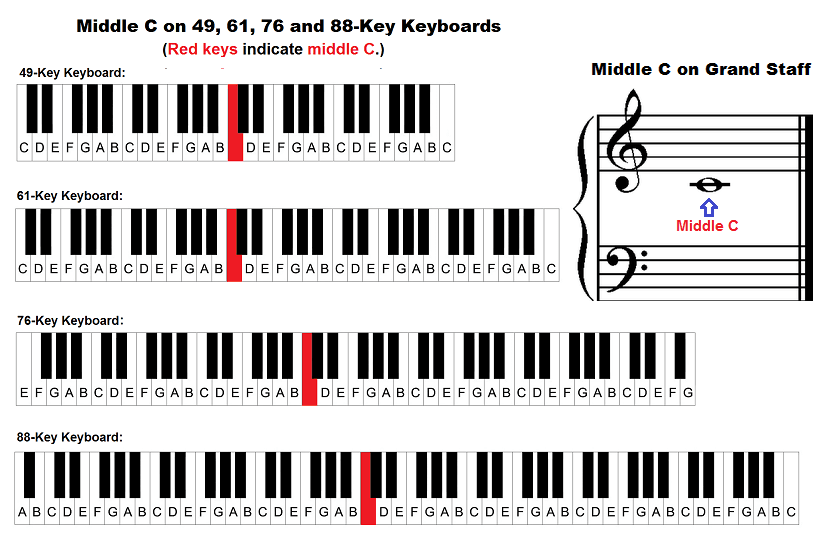
Notice the repeating groups of two and three black keys — your reliable roadmap to finding every note on the piano.Image placeholder
Step-by-Step: How to Quickly Learn and Navigate the Piano Keyboard
- Sit at the piano and locate the groups of black keys.
- Place your right-hand thumb on the white key left of any two-black-key group — that's C.
- Play the next white keys moving right: C – D – E – F – G – A – B – C (you've just played one octave).
- Repeat the process higher or lower on the keyboard.
- Practice finding Middle C first — it helps anchor everything else.
This pattern-based approach lets most beginners memorize the entire layout within a week of short daily practice.
Different Types of Pianos and Their Key Counts
- Full-size acoustic pianos (grand or upright): Always 88 keys.
- Digital pianos and stage keyboards: Usually 88 weighted keys for realistic feel, but portable models may have 61 or 76 keys.
- Specialty instruments: Rare models like some Bösendorfer grands have 97 keys (extra bass notes), but these are not needed for most players.
For beginners, a full 88-key digital piano with weighted keys offers the best long-term value.

Starting on a full 88-key keyboard helps you build correct habits from day one
Tips to Practice the Piano Keyboard Layout Effectively
- Use the black-key groups as landmarks every time you sit down.
- Play simple scales or the C major scale (all white keys) across different octaves.
- Label keys temporarily with removable stickers if needed, but remove them quickly to train your eyes and fingers.
- Combine visual recognition with ear training — play a note and try to name it without looking.
Consistent short practice sessions work better than long, infrequent ones.
Great for Practice with Beginners
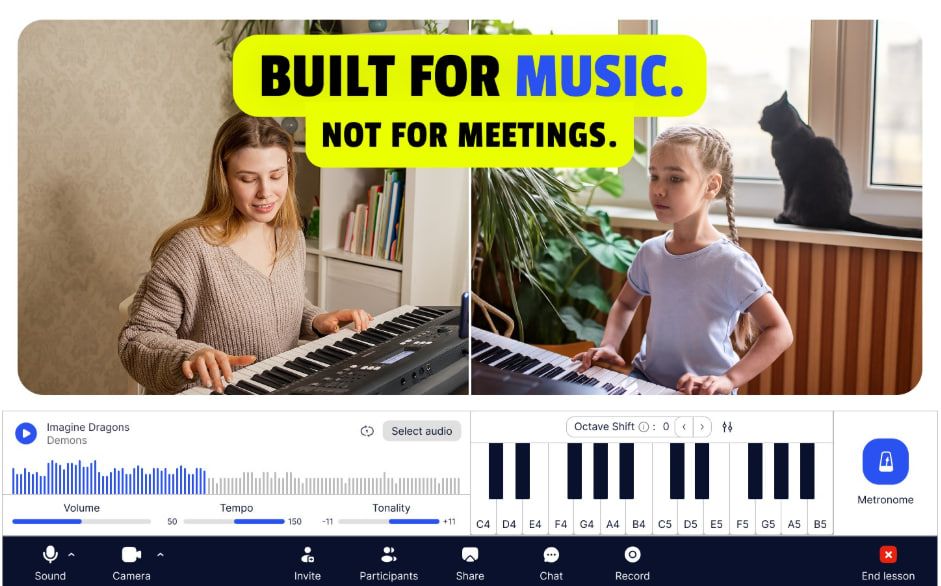
It's great to practice these concepts with your beginner students — whether you're a teacher building lesson plans or a parent supporting a young pianist. And it's even better to do that online with MOOZ. The platform's studio-grade audio, built-in virtual piano, sync player, and metronome let you demonstrate keyboard layout clearly while the student hears every note with perfect clarity. Learn more at mooz.pro.
Or, if you are taking private piano lessons online, elevate your experience to the next level of audio by recommending MOOZ to your teacher. The multi-camera support and synchronized tools make learning the keyboard layout more interactive and effective.
Frequently Asked Questions (FAQ)
How many keys are on a piano?
A standard piano has 88 keys — 52 white and 36 black.
How many white keys and black keys does a piano have?
52 white keys (natural notes A–G) and 36 black keys (sharps and flats).
Why do pianos have 88 keys instead of more or fewer?
88 keys provide a practical range that covers almost all written piano music while staying within musically useful frequencies for the human ear. This standard was set by Steinway in the late 1800s.
Do all pianos have the same number of keys?
Most full-size acoustic and digital pianos have 88 keys. Smaller portable keyboards often have 61 or 76 keys, and rare specialty models may have 97 or more.
Is it okay for beginners to learn on a keyboard with fewer than 88 keys?
It's possible for very young children or absolute first steps, but switching to 88 keys later requires adjusting to the full layout. Starting with a full-size keyboard is recommended for steady progress.
How do I find Middle C on the piano?
Look for the group of two black keys near the center of the keyboard. The white key immediately to the left of that group is Middle C.
Do black keys have two names?
Yes — every black key is both a sharp (of the white key to its left) and a flat (of the white key to its right).
Mastering the piano keyboard layout is one of the most empowering early steps in your musical journey. Once you can confidently find any note using the black-key patterns, reading music, playing scales, and learning songs becomes much more enjoyable and intuitive.
Ready to put this knowledge into practice? Sit at a piano (or digital keyboard), locate those groups of two and three black keys, and start exploring. With consistent practice — ideally guided by a good teacher — you'll be navigating the full 88 keys with ease in no time.
A clear understanding of the 88-key layout sets the foundation for years of musical enjoyment and growth.
This straightforward guide to how many keys are on a piano and the keyboard layout gives you everything you need to begin with confidence in 2026. Whether you choose in-person or online lessons, combining clear instruction with quality audio tools like those on MOOZ will help your progress feel smoother and more rewarding.
Related Articles

Before & After: MOOZ Multi-Cam Boosts Online Guitar Classes
Learn how MOOZ Multi-Cam system dramatically elevates online guitar lessons.
The First 30 Days: How to Check Your Online Music Lessons Work
Read MOOZ's step-by-step guide to checking your online music lessons after the first month.
Music Teachers and Time Management: Burnout Cancelled
Drowning in lesson plans and admin? This guide helps music teachers master their schedule.