
Lesson Lab
Reading violin notes is a smaller job than it looks. A pianist reads two clefs and 88 keys. You read one clef, and in first position about fifteen notes cover nearly everything written for a beginner. Fifteen. The map takes an afternoon to learn. What takes longer is training your eyes to work at the speed of the music.
This guide goes in the order that actually works. Four anchor notes first, then the lines and spaces around them, then note to string to finger, then rhythm, then the bowing marks that no one bothers to explain. At the end there is a ten-minute daily routine that will do more for your reading than an hour of staring at a chart.
One assumption: that the violin already sits under your chin and the bow behaves itself. If it doesn't yet, how to play the violin deals with size, tuning, posture and the bow hold first. Reading is much easier when holding the instrument has stopped taking all your attention.
The violin uses one clef, and that is the whole system
Treble clef, sometimes called the G clef. That curl in the middle wraps around the second line from the bottom, and it is making a specific claim: this line is G. Not any G. It is the G your third finger plays on the D string. Every other note on the page is measured out from there.
Viola reads alto clef, cello reads bass. Violin stays in treble from your first lesson onward, so you learn one set of positions and never relearn it.
👩🏫🎻 Reading is quick to learn and easy to learn crooked. Find your violin teacher on MOOZ →, filter by your level, and book a live lesson.
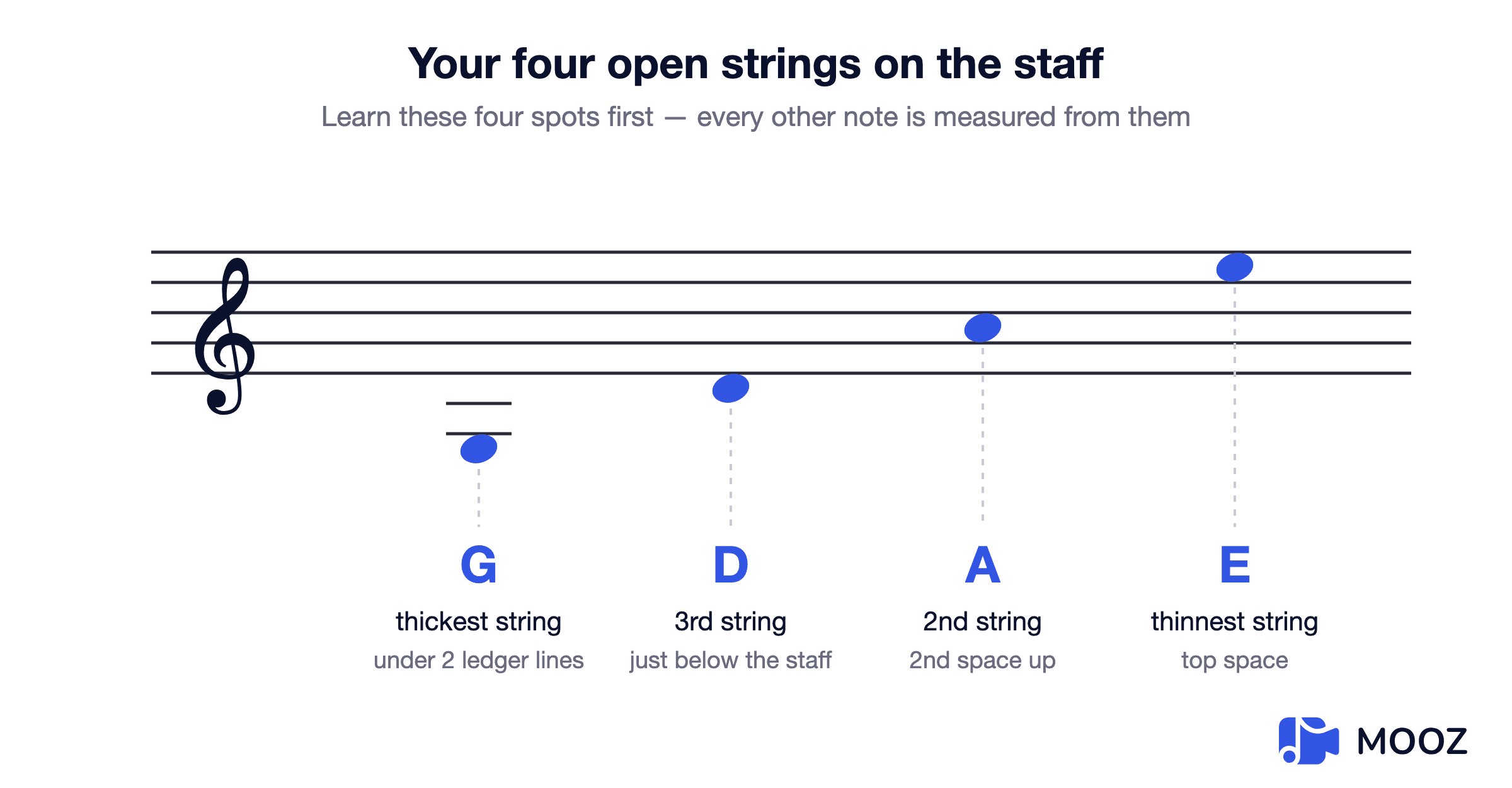
The four open strings on the treble staff
Start with the four open strings
Your open strings are G, D, A and E, from thickest to thinnest, and they sit in four places that are easy to recognise at a glance:
- Open G hangs below the staff, under the second ledger line. It is the lowest note you own.
- Open D sits in the space directly below the bottom line.
- Open A is the second space up, inside the staff.
- Open E is the top space.
For the order, most students use Good Dogs Always Eat, low to high. Say it while you pluck the strings and it sticks in a day.
These four are anchors, and that is more useful than it sounds. When you meet a note you don't recognise, the slow method is to spell the alphabet upward from the bottom line. The fast method is to ask which anchor it is sitting near. One space above open A? That's C. Two lines below open E? You're on the A string.
Try that on real music rather than a chart. Several tunes in our guide to easy violin songs for beginners sit almost entirely on these four notes, so the anchors are the only thing you need to spot.
The nine notes inside the staff
Two mnemonics cover everything between the top and bottom lines.
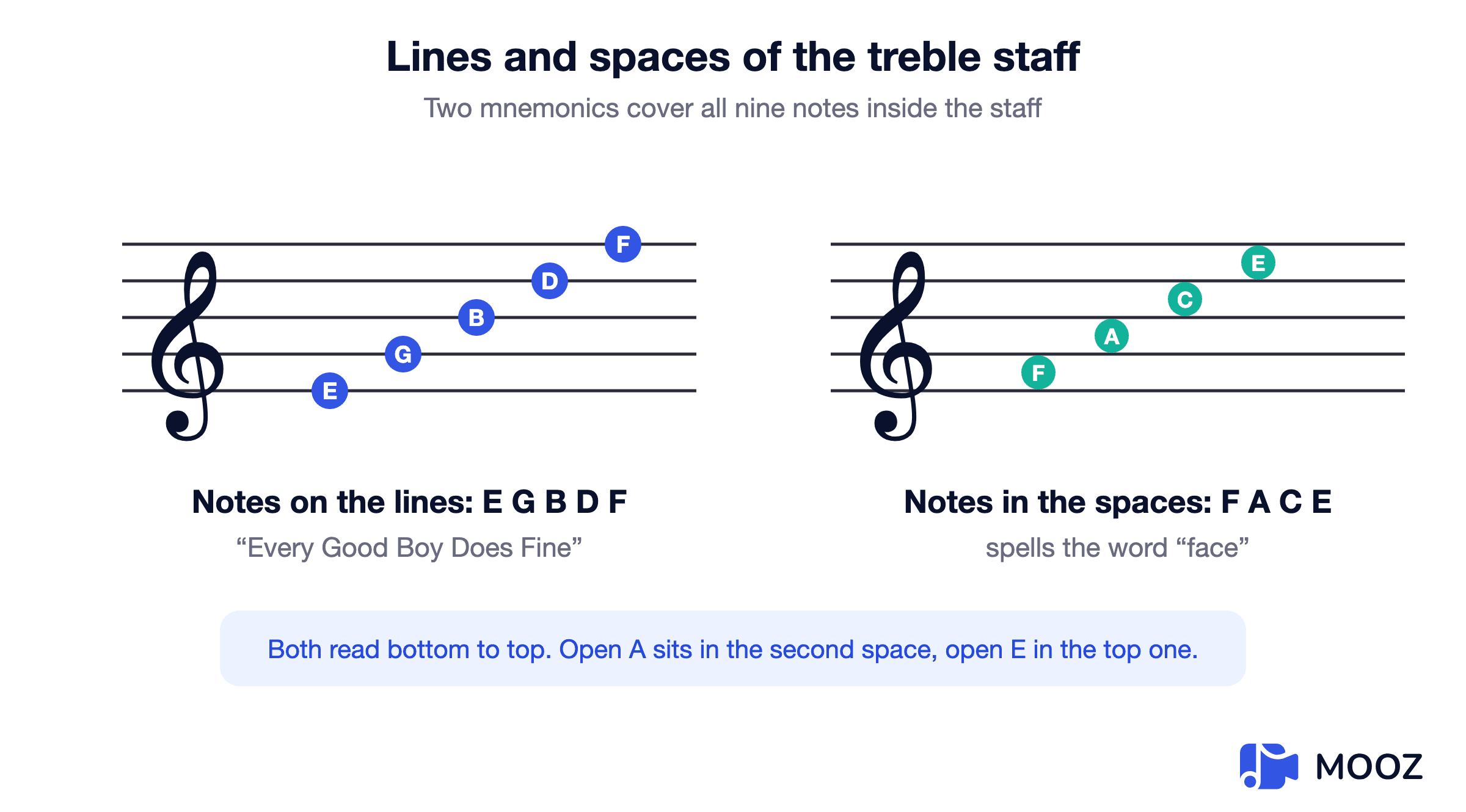
Treble clef lines and spaces: E G B D F and F A C E
Notes sitting on the lines, bottom to top, are E, G, B, D and F. Every Good Boy Does Fine. Notes sitting in the spaces are F, A, C and E, which spells a word for free.
Above and below the staff you start adding ledger lines, and in first position that stays manageable. Below, it is mostly the open G and the notes around the D string. Above, you go as high as B on the E string with your fourth finger.
From the page to your fingers
Here is where violin music notes stop being theory. Every note on the staff means one string plus one finger. In first position with a high second finger, the shape most beginner music is written for, the map looks like this:
G string    0 = G    1 = A    2 = B     3 = C
D string    0 = D    1 = E    2 = F#    3 = G
A string    0 = A    1 = B    2 = C#    3 = D
E string    0 = E    1 = F#   2 = G#    3 = A
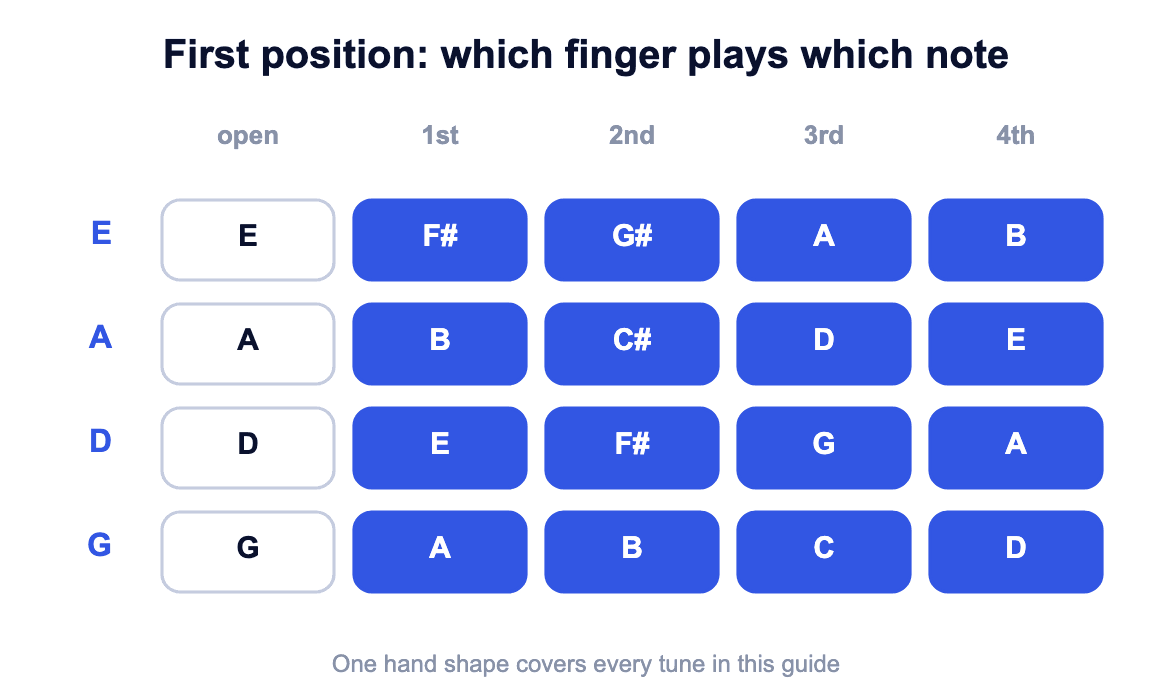
Violin first position finger chart
👩🏫🎻 Not sure your fingers are landing where the notes say? Browse verified violin teachers on MOOZ → and book a trial that fits your schedule.
A zero means the open string, no finger down. Notice that the third finger on one string gives you the same letter as the string above it, one step below its open note, and your fourth finger lands on the same pitch as the next open string. That overlap is why the same note can be fingered two ways, and why teachers write a small 0 or 4 above it to tell you which one they want.
Read distances, not letter names
This is the habit that separates quick readers from slow ones, and almost nobody teaches it directly.
Beginners read one note, name the letter, find the finger, play it, then start the whole process again on the next note. That works at about one note per second, which is slower than most music.
Fluent readers identify the first note of a phrase and then read the shape. Line to the next space up is a step, and on violin a step is usually the next finger. Line to line is a skip, which means jumping a finger or crossing a string. Three notes climbing line, space, line is fingers 1, 2, 3 going up, and you never spelled a single letter.
Practice it deliberately. Take any line of music, name only the first note, and describe the rest as up a step, up a skip, down a step. It feels clumsy for about three days and then it becomes the way you read.
The key signature tells your hand what shape to make
Two sharps at the start of the line, F sharp and C sharp, means D major. Most beginner violin music lives there, and that is not a coincidence. F sharp is where your second finger naturally lands on the D string, C sharp where it lands on the A. Beginner music is full of sharps because sharps fit the violin hand.
The rule people forget: a key signature applies to every octave and every bar until the piece ends, not just the note it is written on. Missing that is the most common reading mistake of the first year, and it shows up as one note that sounds sour every time it comes around.
Half of reading is rhythm
When a student says they can't read violin sheet music, the notes are often fine and the rhythm is guesswork.
A whole note lasts four beats, a half note two, a quarter note one, and two eighth notes fill a single beat between them. The time signature tells you how many beats each bar holds: 4/4 counts to four, 3/4 counts to three and feels like a waltz.
Clap the rhythm and count out loud before you touch the violin. It takes twenty seconds and it removes half the surprises.
The marks that only show up on violin music
Some symbols on a violin notes sheet are yours alone, and they are instructions, not decoration:
- ⊓ is a down bow, pulling from frog to tip. V is an up bow, pushing back. Follow them, or you will run out of bow in the middle of a phrase.
- A slur is a curved line over different notes: play them all in one bow. A tie looks similar but joins two of the same pitch into one longer note, so you play it once and hold.
- Small numbers above the notes are fingers, 1 to 4, with 0 for an open string. Guitarists trip over this constantly, because there the numbers mean frets.
- Roman numerals or "sul G" tell you to play a passage on one specific string, usually for the tone colour rather than convenience.
- pizz. means put the bow down and pluck. arco means pick it back up.
Ten minutes a day, and it comes quickly
Reading improves with short daily contact, not long weekend sessions. Ten minutes:
- Two minutes on anchors. Point at the four open strings on any page of music and name them out loud. Then play them.
- Three minutes naming, no violin. Take a line of music and say the note names in a steady rhythm, slow enough that you never stop. Speed comes from not stopping.
- Three minutes play-and-say. Same line, now say the name as you play it. This is what welds the page to your hand.
- Two minutes on rhythm alone. Clap and count a line you have never seen.
One rule holds the whole thing together: read something new every day and do not go back to fix mistakes. Reading is the skill of keeping going. Correcting is a different skill, and practising them at the same time makes you worse at both.
What keeps beginners slow
- Learning tunes only from finger charts and finger numbers, so the staff never becomes familiar.
- Stopping at every wrong note. It trains hesitation.
- Reading so slowly that the tune never appears. If you can't hear what it is, your ear can't help you, and your ear is the fastest proofreader you have.
- Checking the key signature after the note sounds wrong instead of before you start.
- Only ever reading music you already know by ear, which lets you fake it indefinitely.
FAQ: reading violin notes
How long does it take to learn to read violin notes?
Most adults can name every note in first position within two or three weeks of short daily practice. Reading at tempo, without translating in your head, usually takes a few months. Children take longer to start and then tend to overtake adults.
Do violinists need to read bass clef?
No. Violin music is written in treble clef, with occasional short passages in a higher octave marked 8va. Viola players read alto clef and cellists read bass, which is one reason swapping instruments means relearning the page.
What do the numbers on violin sheet music mean?
Fingers, not positions or frets. 1 is your index finger, 4 your little finger, and 0 means play the open string with no finger down. String indications appear separately, as Roman numerals or instructions like sul G.
Can I learn the violin without reading music?
Yes, and plenty of fiddle and folk players do exactly that. It limits which music is available to you, though, and it makes lessons harder to follow, since almost every teacher points at a page. Reading and playing by ear support each other rather than competing.
Why is beginner violin music always in sharps?
Because the violin is tuned in fifths, G D A E, and the keys with one to three sharps sit under the hand without any stretching. D major, A major and G major use your natural first-position finger spacing. The same music in flat keys would need low first fingers and half steps that are awkward before your hand is set.
Is violin sheet music the same as piano sheet music?
The treble line is the same notation, so you can read a piano right hand and play it on violin if the range fits. What differs is everything practical: bowings, fingerings, string indications and chords you cannot physically play on four strings with one bow.
Where a teacher makes this fast instead of slow
Reading is one of the few parts of violin you can genuinely drill on your own. The catch is that reading practice quietly builds technique at the same time, and technique is the part you cannot see yourself doing.
A student learning to read alone almost always starts stopping the bow whenever the eyes get busy, or gripping the neck harder while concentrating, or dropping the left wrist to reach a note that a small elbow movement would have delivered. Six weeks later those are habits, and habits take a lot longer to remove than they took to build.
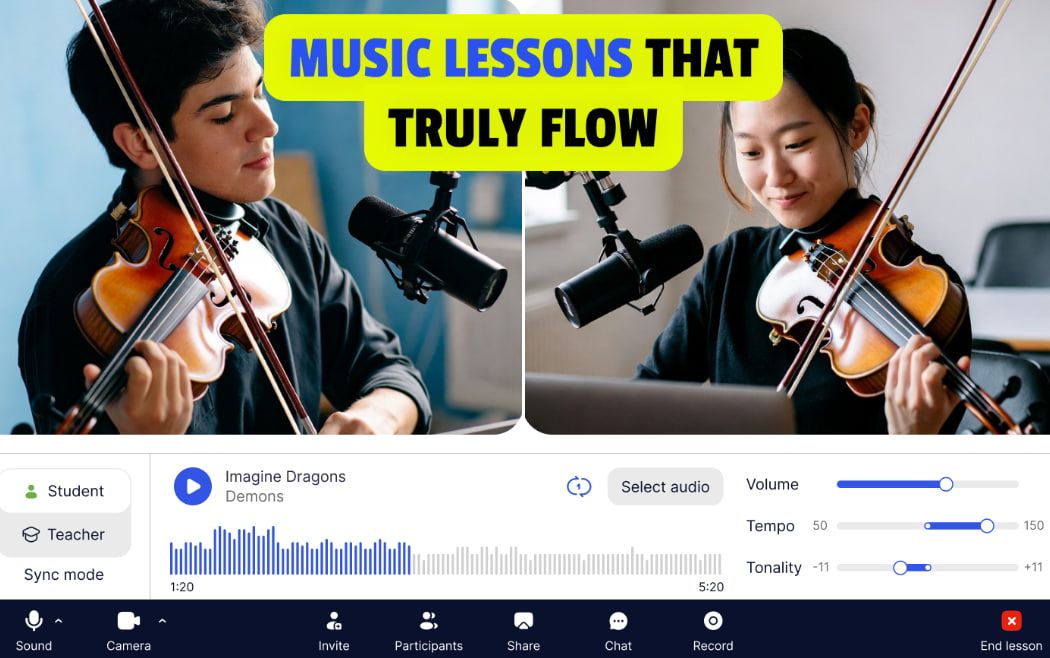
A live online violin lesson on MOOZ, with a clear view of the bow and both hands
A teacher catches all three in the first ten minutes. If you are learning online, the video call matters more than people expect: ordinary calls compress the sound and give you one fixed camera angle, so tone and bow contact simply do not survive the trip. A platform built for music keeps the audio intact and shows both hands at once, with a tuner and metronome already in the window. You can browse verified violin teachers on MOOZ, filter by country, level and price, and book a lesson directly.
Still weighing up whether to learn in person or on screen? We went through the trade-offs in private violin teacher vs online classes.
Next steps
- Print one page of easy music today and mark every open string you can find on it. That is your anchor drill done.
- Tomorrow, name a line out loud without playing, then play it saying the names. Ten minutes, no going back to fix things.
- Put it on the instrument with music you can already hear. The 15 easy violin songs for beginners all stay in first position, so nothing new gets in the way of the reading.
- Book a 30-minute trial with a violin teacher on MOOZ and ask them to watch your bow and left wrist while you sight-read.
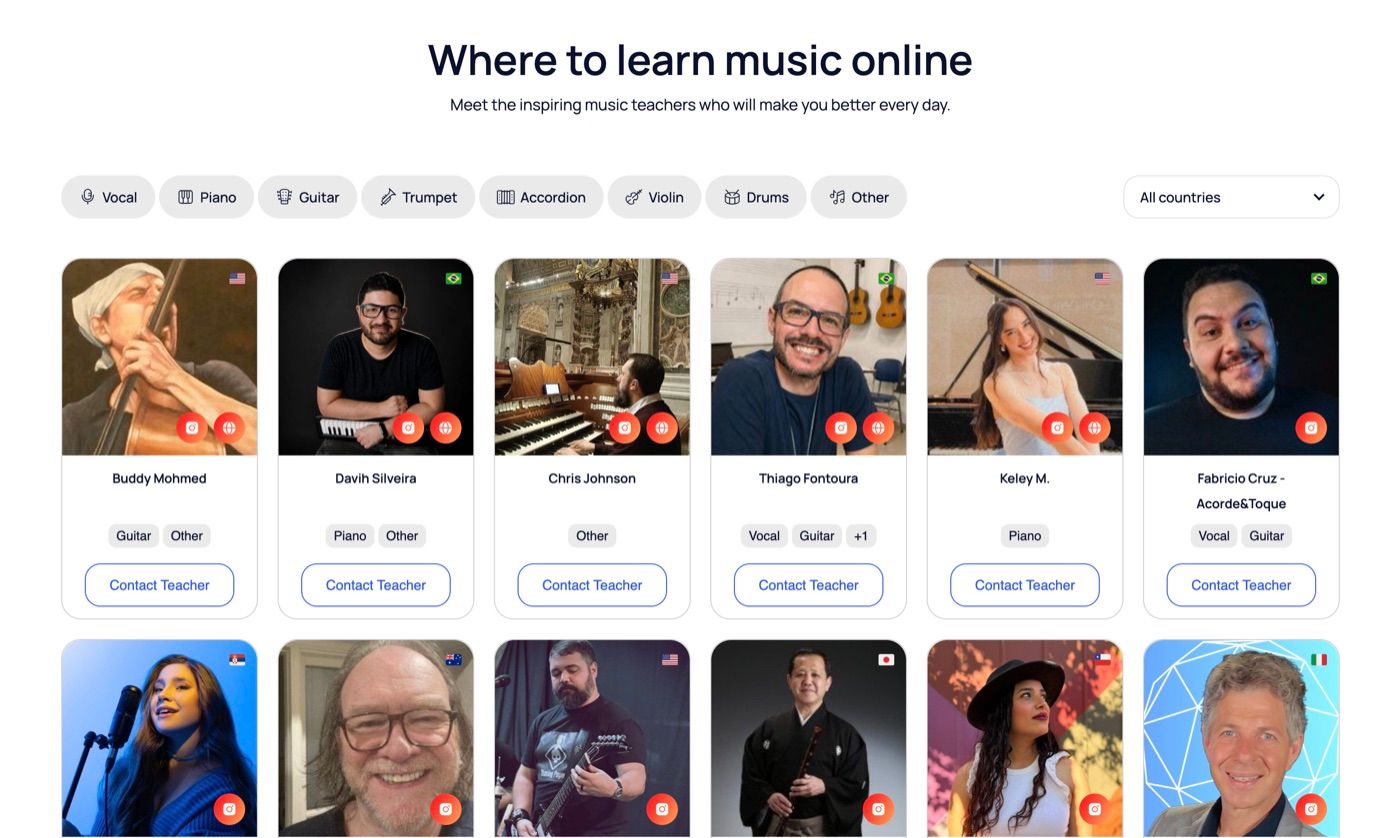
Browse verified violin teachers on MOOZ and filter by country and style
Four anchors, nine notes inside the staff, one hand shape. Learn those and the rest of the page stops being a wall of dots and starts being directions.
Related Articles

Synchronization in Online Music Lessons: A Complete Breakdown
Learn how tech fixes internet latency. Make synchronous music today!
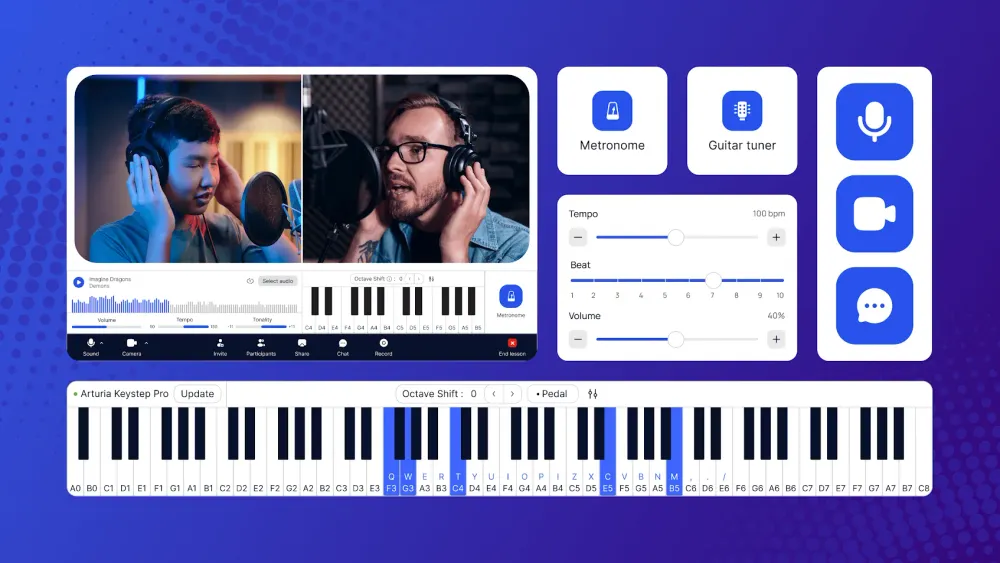
How to Start Your First Lesson in MOOZ: A Step-by-Step Guide
Read MOOZ step-by-step guide to make your first class smooth, professional, and perfectly in tune.

Guide to Teach Music Online Smarter: MOOZ & Moosiko Insights
Learn how to solve the 5 biggest online teaching challenges that are costing you time and students.