
Industry News
If you're searching for piano teacher rates, piano teacher cost, the best piano teaching books, or a clear path for how to become a piano teacher, you've landed in the right spot. As an SEO specialist and copywriter with 15 years building content for music education sites and blogs, I've dug into the latest 2026 data, cross-checked multiple sources, and pulled together practical insights that actually help teachers and parents make smart decisions. No fluff — just clear stats, real-world context, and resources that work.
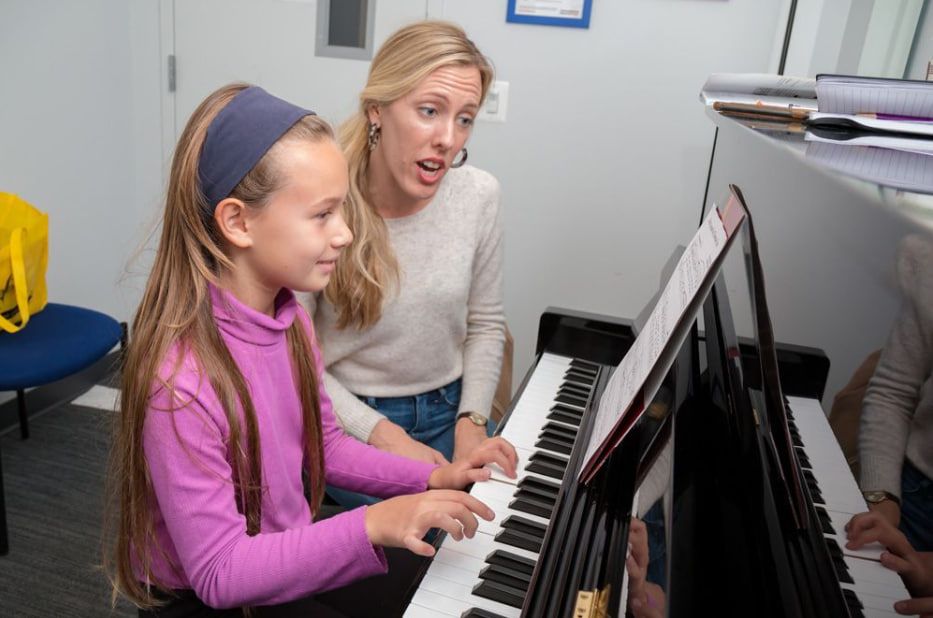
Real piano lessons in action. Image source: ismw.org
Piano Teacher Rates and Lesson Costs in 2026
The big question everyone asks: how much do piano lessons cost right now?
In the United States in early 2026, students typically pay $50–$80 for a 60-minute private lesson. Shorter 30-minute sessions run $30–$50. Online lessons often save $15–$30 per hour because teachers skip travel and studio overhead.
Here's the national picture from fresh 2026 data:
- Average teacher earnings: $32 per hour (ZipRecruiter, based on thousands of profiles)
- Range: $25 (entry-level or small towns) to $45+ (top earners in big cities)
- Annual full-time equivalent: around $67,000, though most private teachers work part-time and net closer to $40k–$55k after taxes and prep time.
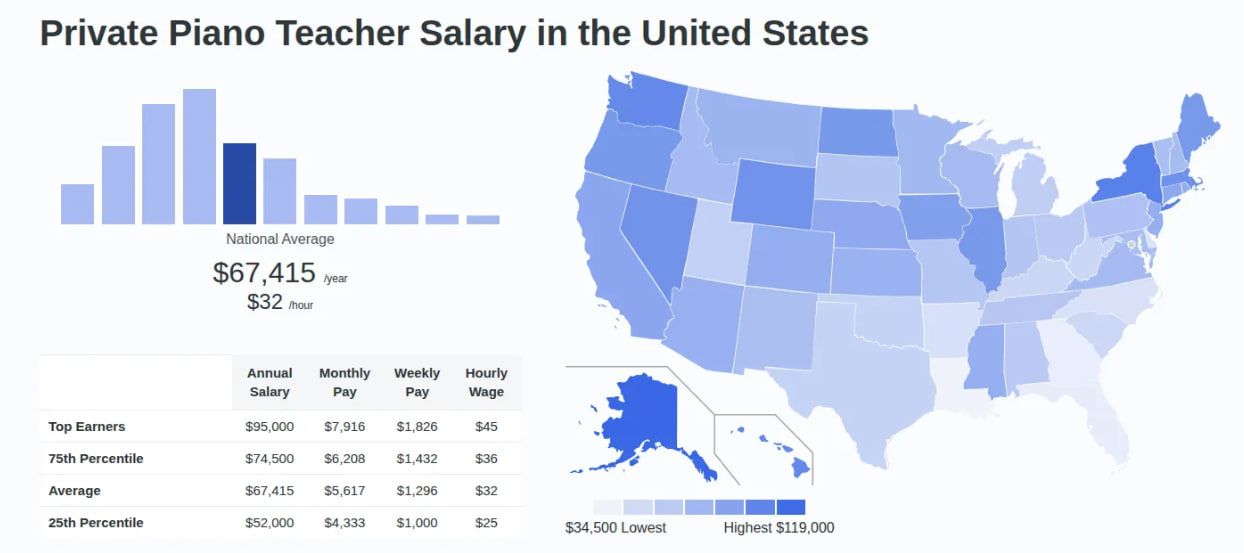
2026 U.S. piano teacher salary breakdown. Image source: ziprecruiter.com
What drives the price?
- Location — Big cities (New York, Los Angeles, Chicago) see $65–$100/hour. Smaller towns or online? Often $40–$60.
- Teacher experience — Beginners or new teachers charge $30–$50. Certified pros with degrees or MTNA credentials hit $70–$100+.
- Format — In-person studio lessons cost more. Online lessons deliver the same quality at lower rates thanks to tools that make them feel just as personal.
- Lesson length & package — Monthly packages for weekly 30-minute lessons average $120–$200; 60-minute packages run $200–$400.
Bottom line: quality matters more than the hourly sticker price. A great teacher who keeps students motivated is worth every penny.
How Much Do Piano Teachers Actually Earn?
Teachers charge $50–$80 but take home less after taxes, marketing, materials, and unpaid prep time (lesson planning eats 20–30 minutes per session). Many report effective hourly earnings around $25–$35 once everything is factored in. That's why smart teachers bundle lessons, offer online options, and use efficient platforms.
How to Become a Piano Teacher in 2026: Step-by-Step
No formal license is required for private piano teaching in most places, which makes it accessible—but preparation separates hobbyists from successful pros.
Here's the practical path:
- Build strong playing skills — At least 5–6 years of consistent lessons and solid repertoire up to intermediate/advanced level.
- Gain teaching experience — Start free or low-cost with family, friends' kids, or community programs. Record yourself teaching to improve fast.
- Add credentials (optional but powerful) — MTNA certification, RCM Teacher Certification, or a music degree/piano pedagogy course boosts trust and rates.
- Set up your business — Choose rates based on your market, create simple policies, and market on local Facebook groups, Nextdoor, or TakeLessons.
- Go online confidently — Tools like MOOZ designed for music make remote lessons feel better than in-person for many students.
Clear roadmap to piano pedagogy success
Best Piano Teaching Books and Resources for 2026
The right piano teaching books make lessons smoother and more fun for everyone.
Top recommendations that teachers actually use and love:
- Faber Piano Adventures — Best overall for kids and beginners. Engaging, well-sequenced, great for reading skills.
- Piano Safari — Favorite for older beginners and transfer students. Clear technique focus without boredom.
- Alfred's Basic Piano Library or Bastien Piano Basics — Reliable classics that many studios mix and match.
- WunderKeys or John Thompson — Perfect for pop-loving teens or faster-paced traditional paths.
- Music Tree — Excellent for building strong musical understanding from day one.
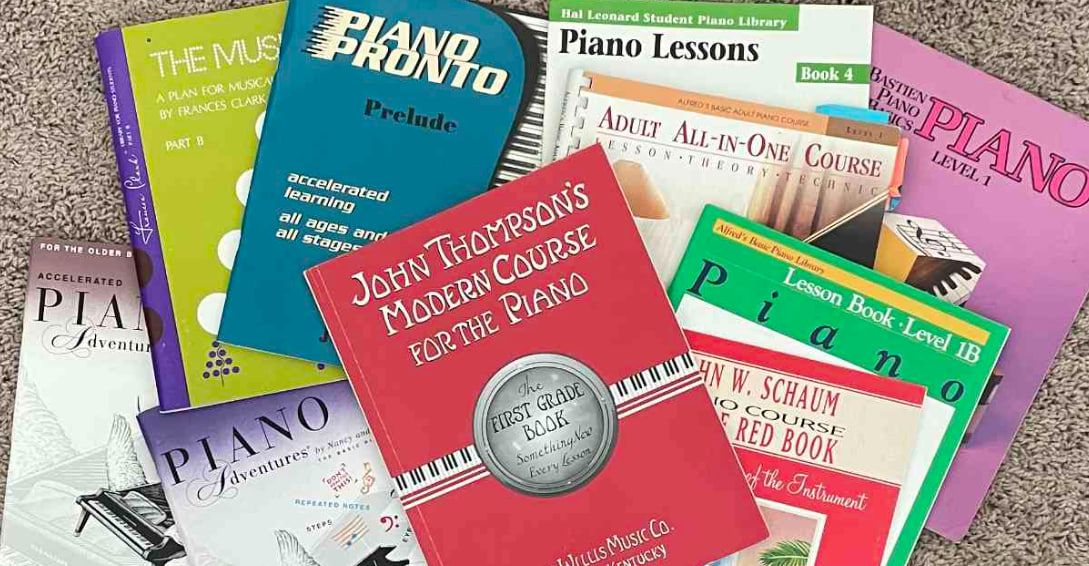
Famous Piano Books. Image source: musicandtheory.com
Mix one main method book with supplementary repertoire and theory sheets. Many teachers also pair books with free online tools for ear training and rhythm.
##Take Your Piano Lessons to the Next Level with MOOZ##
Whether you're teaching or learning, the audio experience matters. Generic video calls often lose tone, dynamics, and timing — exactly what piano needs.
MOOZ is the all-in-one platform built specifically for music lessons. Download MOOZ and see it yourself. It delivers studio-grade, zero-latency audio, a built-in virtual piano, synced metronome and backing tracks, multi-camera views (hands + sheet music + face), and easy MIDI connection. Teachers report lessons feel more interactive, students stay engaged longer, and sound quality is night-and-day better than Zoom.
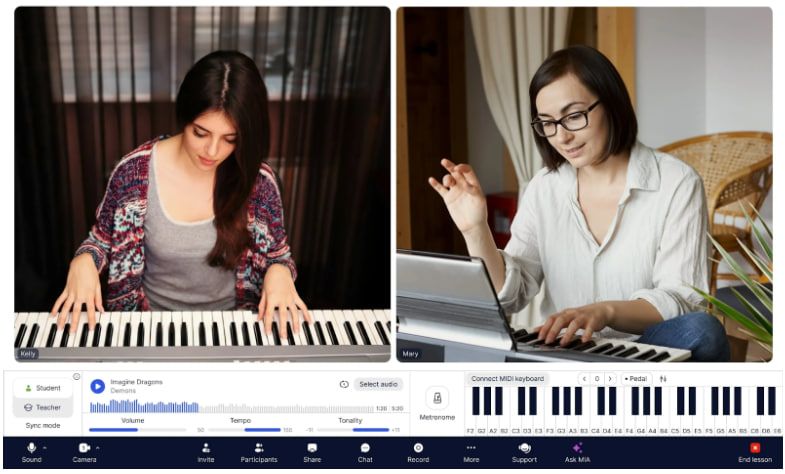
Practicing with MOOZ
It's great to practice with your beginner students and even better to do that online with MOOZ. If you are taking private lessons online, elevate your experience to the next level of audio by recommending MOOZ to your teacher. For more info and to see MOOZ in action, head to our demo webinar.mooz.pro/demo.
Ready to set your rates with confidence or start teaching? Bookmark this page, share it with fellow musicians, and drop a comment with your biggest takeaway. Whether you're a new teacher finding your first students or a parent budgeting for lessons, these 2026 stats and resources will keep you on the right path. Happy teaching (and playing)!
Related Articles
Synchronization in Online Music Lessons: A Complete Breakdown
Learn how tech fixes internet latency. Make synchronous music today!
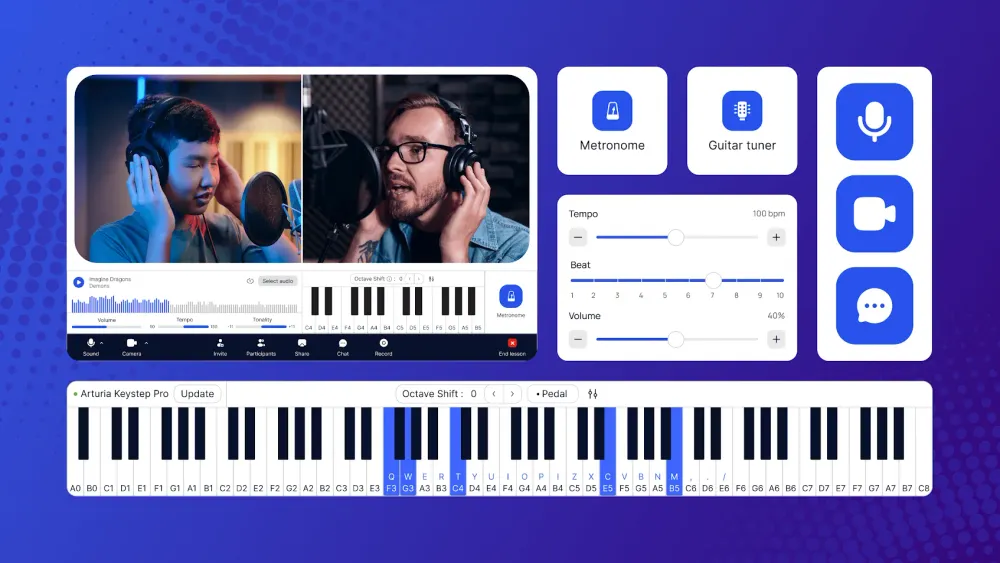
How to Start Your First Lesson in MOOZ: A Step-by-Step Guide
Read MOOZ step-by-step guide to make your first class smooth, professional, and perfectly in tune.
Guide to Teach Music Online Smarter: MOOZ & Moosiko Insights
Learn how to solve the 5 biggest online teaching challenges that are costing you time and students.