
Lesson Lab
Most of what search returns for "violin sheet music" is a concerto reduction or a pop arrangement full of shifts — the left hand sliding to a new place on the fingerboard — and double stops, two strings bowed at once. Useful eventually. Useless in month one.
Beginner violin sheet music is a much smaller thing: a short melody that stays in first position, finger numbers printed over the notes, and a page you can put on a stand today. First position just means the hand parked at the top of the fingerboard, nearest the scroll, reaching no further than the fourth finger — no sliding anywhere.
This article is that page — a free 12-page pack of ten public-domain tunes — plus how to practise from it and where to look next without landing on a copyrighted chart by accident.
The free pack — 10 first-position tunes
Twelve pages: a cover, a first-position map, and ten tunes in the order worth learning them. Public-domain melodies, engraved fresh, finger numbers on every note.
Download the pack (PDF, 12 pages) →
Print at 100%. Do not use "fit to page" — it shrinks the staff and hides the finger numbers, which are the entire point.
| Piece | Why it comes here | Strings used |
|---|---|---|
| Hot Cross Buns | Three notes, one string, nothing to cross. | D only |
| Mary Had a Little Lamb | The same shape, moved to the A string. | A and open E |
| Twinkle Twinkle Little Star | First two-string crossing. | A and E |
| Frère Jacques | Introduces eighth notes. | D and A |
| Ode to Joy | Stepwise, with a dotted quarter. | D and A |
| Lightly Row | Suzuki Book 1 staple. | A and E |
| Au Clair de la Lune | Four pitches, long bows. | D and A |
| Jingle Bells (chorus) | Repeated open E. | E and A |
| London Bridge | Stepwise D-major line. | D and A |
| Go Tell Aunt Rhody | Folk tune, last page of the pack. | D and A |
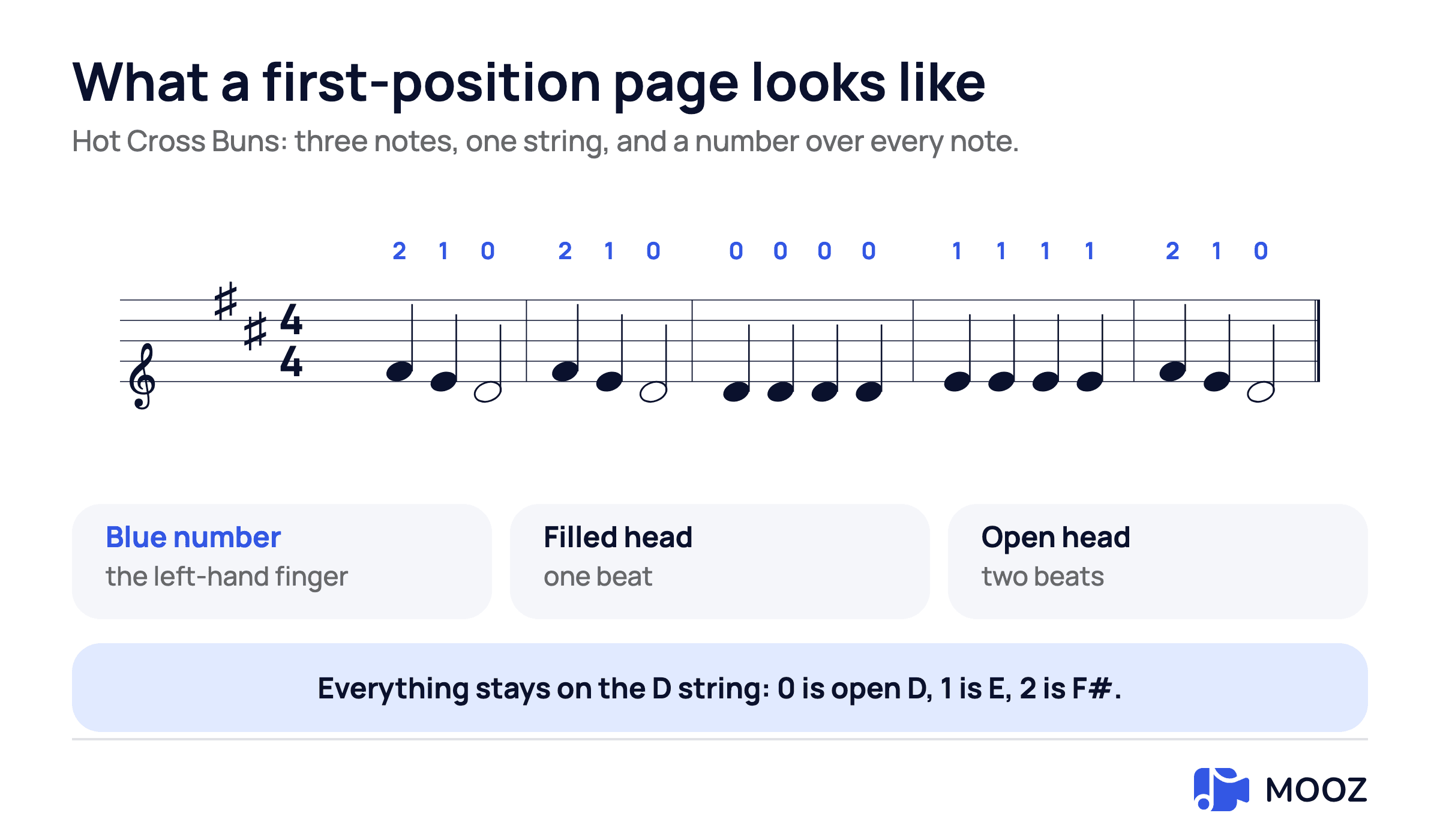
Five bars, one string, and a number over every note — this is what a beginner page should look like.
🎻👩🏫 Printed the pack? A teacher hears a flat second finger in the first bar, and fixes it before it sets. Find a violin teacher on MOOZ and bring the pack to your first lesson → — your teacher sends the link, you install free.
Play them in that order. The left hand learns one new problem per page — a new string, a crossing, then an eighth note — rather than four at once.
How to read beginner violin sheet music
Six things, in the order you will actually need them, and then the page stops being a wall.
- The number above a note is the left-hand finger, not the fret and not the string: 0 open, 1 index, 2 middle, 3 ring. This is the one you play from.
- Which string comes from where the note sits on the staff. The higher on the staff, the higher the string. That matters most for 0, which can mean any of the four open strings depending on how high it sits.
- A filled note head is a quarter, one beat. An open head with a stem is a half — hold it for two. An open head with no stem is a whole note, four beats. Two heads joined by a beam are eighths, half a beat each, and a dot after a head adds half its length again.
- Treble clef. Every violin part uses it. The bottom line is E and the top line is F. Careful with that bottom-line E: it is the first finger on the D string, not the open E. The open E string is the high one, up near the top of the staff.
- Two sharps at the start — F# and C# — means D major, the home key for almost all first-position beginner material, which is why the whole pack sits in it. It also means the F on that top line is always F#, never plain F.
- 4/4 unless marked otherwise. Four quarter notes fill a bar.
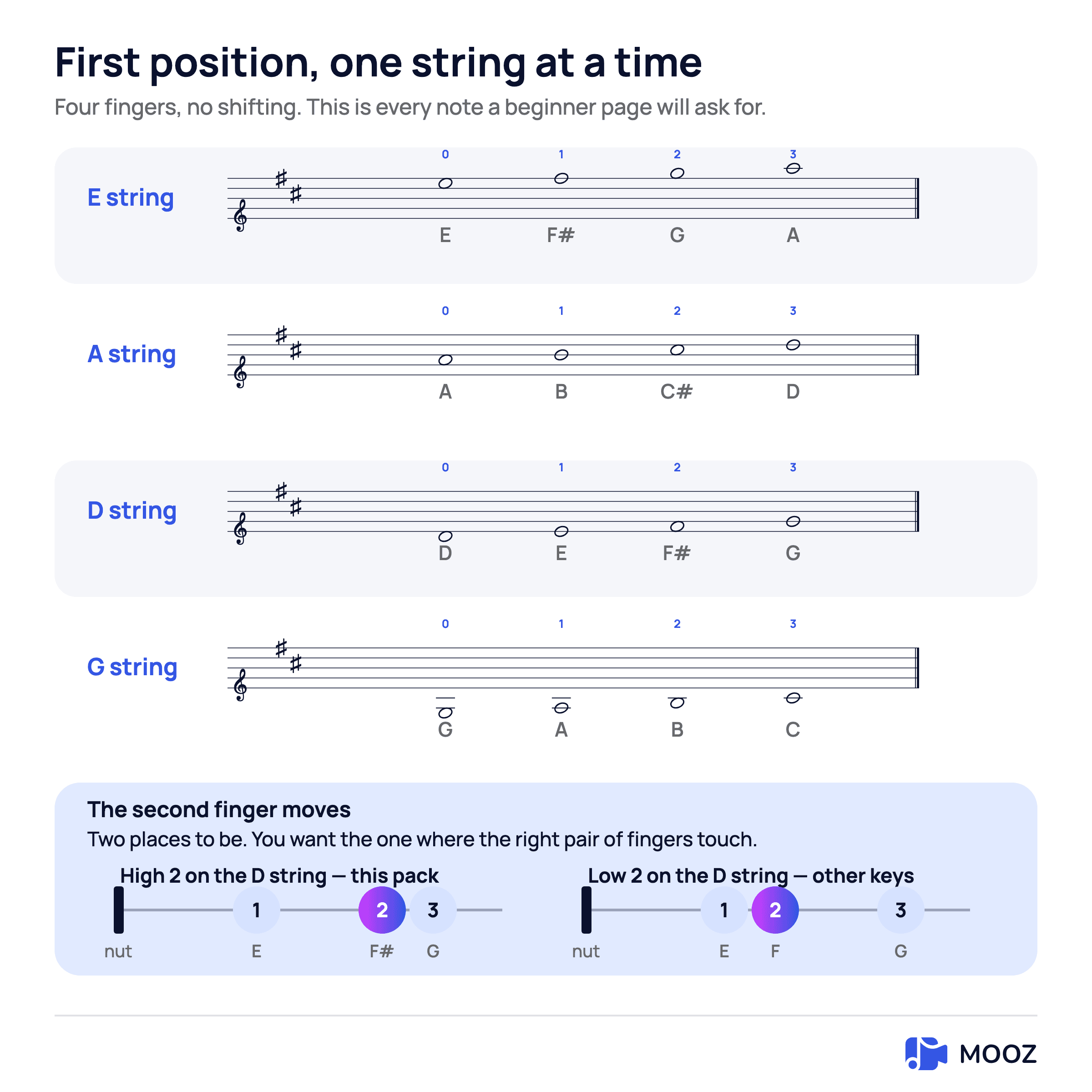
Every note a first-position page can ask for, string by string.
🎻🎓 Teaching violin? Run the lesson in MOOZ: full-range sound that keeps the tone, up to five cameras on the computer for the bow hand, and a metronome inside the call. Students join free. Get your personal MOOZ setup →
The one that catches people: in D major the second finger is high. F# and C# sit right next to the third finger, not next to the first. If your F# sounds flat, that is almost always the reason — and it is the single most common thing a teacher fixes in a first lesson.
If the staff itself is still unfamiliar, violin notes for beginners covers naming notes on the staff, and how to read sheet music goes through notation from the ground up for any instrument.
How to practise from a PDF
- Print piece 1, Hot Cross Buns. It is the third sheet in the pack — page one is the cover. A phone screen hides the finger number at exactly the moment you look down at the bow.
- Name the notes out loud before you play them. Then pluck them with a fingertip, which is what pizzicato means. Then bow. Three passes, and the third one is the first that sounds like music.
- Metronome at 60 to 70. One note per click until every pitch matches a tuner.
- One page a week is enough. Adding three PDFs in two days produces three sloppy tunes and no clean one.
- Record twenty seconds. If the F# is flat, your second finger is sitting next to 1. Move it next to 3 and record again.
A PDF cannot hear a flat second finger. That is the whole limitation of learning from a page, and it is worth being honest about it before you spend three months cementing one.
What counts as beginner violin sheet music
Once you reach page ten you will go looking for more, and this is the filter to take with you. A page that works passes five checks. If it fails one, skip it, even when the title says "easy".
- First position only. No shifts, no excerpts that wander up to fifth position.
- Fingers 0 to 3. Fourth finger is optional later, never required on page one.
- Mostly quarters and halves. A few eighths are fine. Sixteenth-note runs are not.
- One melody line. No double stops, no piano reduction squeezed onto the same staff.
- Finger numbers printed. A beginner should not have to work out whether that F# is 2 on the D string or 1 on the E.
Easy violin sheet music and simple violin sheet music are the same search with different words: a tune the left hand can hold still for. Plain "violin sheet music" without those filters returns Brahms. Filter before you print.
Where else to find free violin sheet music, legally
Use libraries that mark the licence, and do not grab the first "free PDF" of something written in 1998.
| Source | Good for | Skip when |
|---|---|---|
| This MOOZ pack | Ten first-position tunes with fingerings printed. | You have already finished page 10. |
| IMSLP / Petrucci | Public-domain method books and folk collections. | The scan is a full sonata — filter for "beginner" or first position. |
| MuseScore (public-domain filter on) | User engravings of folk tunes and hymns. | An uploader has tagged a current pop song "easy". It is still copyrighted. |
| Local library or music shop | Suzuki Book 1 and similar, properly bought or borrowed. | Someone offers you a photocopied Book 1 from a forum. That is a copy, not a free edition. |
Public domain means the melody's copyright has expired — nursery rhymes, folk tunes, Beethoven's theme, hymns published in the nineteenth century. Worth knowing: a new engraving of a public-domain melody can still carry the engraver's own licence, so the tune being old does not automatically make a particular PDF free. The pack on this page is released for personal practice and for teachers to use in lessons. Don't sell it or strip the attribution.
Read it with a teacher on MOOZ
Sheet music PDFs fail for one reason far more than any other: the student plays the right finger on the wrong pitch and keeps going, because nothing on the page objects. A teacher stops the bar, moves the fingertip two millimetres, and makes you rebuild the note until it rings.
MOOZ keeps that correction inside a music classroom rather than a video call: full-frequency audio, so your teacher hears the difference between a scratchy bow and a clean one instead of a flattened version of both; extra cameras on the left hand and the bow at the same time; and a metronome and annotation on the same page you just printed.
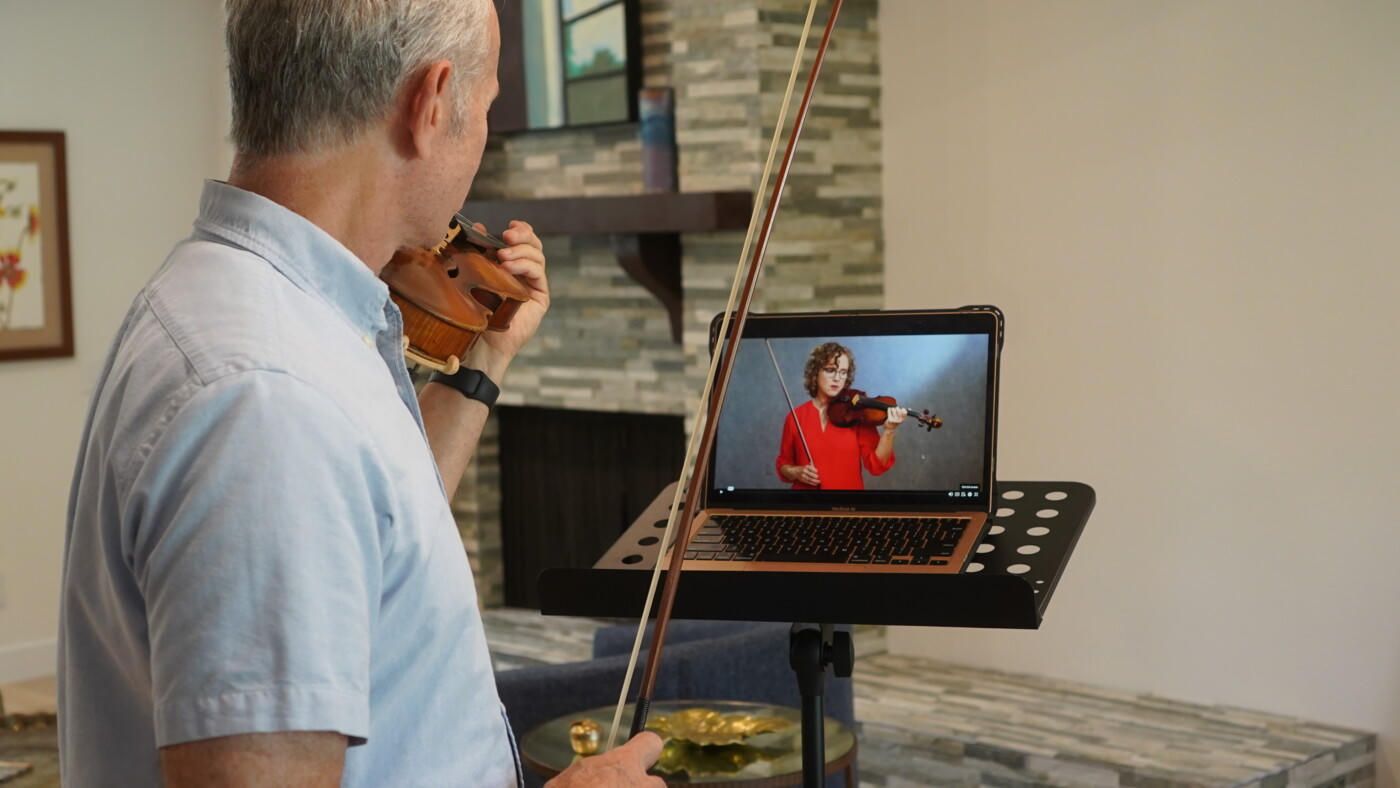
A violin lesson needs the bow and the spot where it meets the string on screen, not just a face.
Teachers keep public profiles in the directory — filter by instrument, language and style, read what they actually teach, and contact them directly. Students never pay a platform fee.
Bring Hot Cross Buns or Twinkle to the first lesson. Thirty minutes is enough for a first-position check. If you are still deciding whether to start at all, how to play the violin covers the first month end to end, and easy violin songs for beginners adds fifteen more tunes once the pack is finished.
FAQ
Where can I download free violin sheet music as a PDF?
Start with the ten-tune pack linked above. After that, IMSLP for public-domain method books and MuseScore with the public-domain filter switched on. Avoid "free" uploads of current pop songs — those are unlicensed copies, not free sheet music.
What is the easiest beginner violin sheet music to start with?
Hot Cross Buns on the D string: three pitches, no string change, all quarters and halves. Mary Had a Little Lamb on the A string is the same pattern one string higher, which is why it comes second.
What does "first position" mean?
The left hand sits at the top of the fingerboard, nearest the scroll, and stays there. Each finger has one place to be, and you never slide the hand to reach a note. Everything in this pack is written that way, which is why four fingers and four strings cover all ten tunes.
Do I need to read sheet music to start the violin?
You can start on finger numbers and open-string names, and plenty of people do. You will hit a wall when the next piece exists only on a staff. Learning the staff on these ten tunes, where you already know how the tune goes, is the cheap way through that wall.
Is easy violin sheet music the same as simple violin sheet music?
In search terms, yes — both mean first position, limited fingers, simple rhythm. If a file labelled "easy" asks for third position or a long stretch, it is mislabelled. Check the page before you trust the title.
Can I use a tablet instead of printing the PDF?
Yes, if the staff is large enough to read while you are looking at the bow rather than the screen. Most phones are not. A tablet on a stand works. In month one a printed page still wins, because you can write on it.
Are these PDFs legal to share with a student?
The melodies are public domain and this pack is released for personal practice, so a teacher may use it in a lesson freely. Do not upload it to a paid storefront or remove the attribution.
Next step
Print piece 1, Hot Cross Buns — the third sheet in the pack. Tune. Play it pizzicato, then bowed, tuner on. When the three pitches are stable, book a 30-minute trial and have a teacher check that second finger before it freezes in the wrong place.
Free violin sheet music for beginners is a first-position PDF, not a search result you gamble on. Ten public-domain tunes, finger numbers, a tuner, and one weekly pair of eyes on the bow. That is the download that actually gets used.
Related Articles
Zoom for Music Lessons: Best Audio Settings (and When to Switch)
The Zoom settings that stop it cutting off a sustained note: Original sound for musicians, high-fidelity music mode, echo cancellation, auto-gain. And the point where settings stop being enough.
10 Vocal Warm-Up Exercises Every Singer Should Know
Ten vocal warm-up exercises explained: what each one does, how to do it, and the mistake that makes it useless. Plus a five-minute routine and choir warm-ups.

Best Apps for Music Teachers in 2026: Lessons, Practice & Admin
The apps a music teacher needs in 2026: a lesson room built for sound, sheet music, practice tools for students and studio admin, with current prices.