
Lesson Lab
Chord charts ask you to learn six things at once. Tab asks you to learn two: which string, which fret. That's most of why beginners get further with it in their first week.
Below are 15 easy guitar tabs for beginners. First, how to read tab at all. Then 12 melodies you already know by ear, and 3 drills that build the hand strength those melodies quietly demand. Everything stays in the first four frets, and each one comes with the tip that actually makes it sound right.
Worth knowing before you start: tab tells you where to put your fingers and nothing at all about rhythm or pitch. When you want the other half of the picture, how to read sheet music covers standard notation from the staff up, and it applies to every instrument rather than just this one.
👩🏫🎸 A teacher who can hear you play will catch in one lesson what takes months to spot on your own. Find your guitar teacher on MOOZ →, filter by your area, and book a live lesson.
How to read guitar tab
Six lines, six strings. The top line is your thinnest string, the one that sounds highest. The bottom line is the fat one. A number sitting on a line tells you which fret to press on that string, and a 0 means play it open with no finger down. Read left to right, one note at a time.
The part that trips people up: the top line is the highest-sounding string, not the one closest to your chin. Hold the guitar in playing position and the thin string is the one nearest the floor.
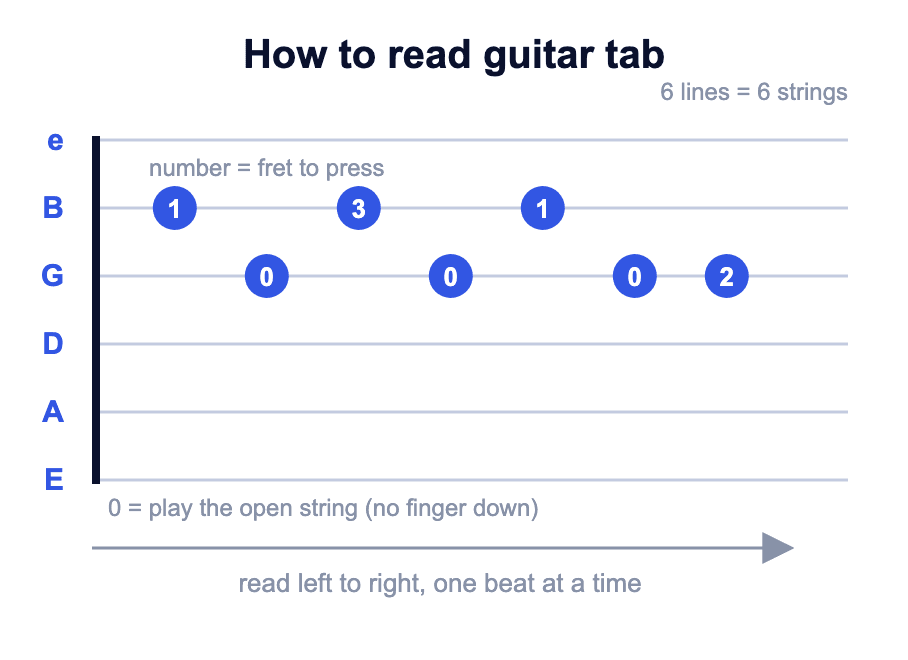
How to read guitar tab
Two things about the tabs below. When a riff only uses two or three strings, the tab prints just those lines. Anything wider gets all six, so you can count string positions without working out which lines were left off. Each tab is also broken into short stacked lines, one per musical phrase, the same way sheet music wraps.
What tab won't give you is rhythm. It shows which note and which finger, not how long to hold it. That's fine here, because you already know how these go. Hum the tune, then match it.
12 melodies you already know
1. Ode to Joy
Nothing moves more than two frets at a time, which is why this is the first thing most teachers hand a beginner. Play it slowly enough that every note rings clean before you move off it.
e|-0-0-1-3-3-1-0---|
B|---------------3-|

e|-------0-0-------|
B|-1-1-3-----3-3---|

e|-0-0-1-3-3-1-0---|
B|---------------3-|

e|-------0---------|
B|-1-1-3---3-1-1---|
2. Happy Birthday
This one repeats the same note a lot, and if the notes ring into each other it turns to mush. Lift your finger the moment you pluck the next one. That tiny bit of silence is what makes it sound deliberate rather than smeared.
e|---------------|
B|---------1-0---|
G|-0-0-2-0-------|

e|---------------|
B|---------3-1---|
G|-0-0-2-0-------|

e|-----3-0-------|
B|---------1-0---|
G|-0-0---------2-|

e|-1-1-0---------|
B|-------1-3-1---|
G|---------------|
3. Amazing Grace
Count in three: one-two-three, one-two-three. Let every note ring its full length. Rushing is the single most common way to make this one sound wrong.
e|-------------------|
B|-----0---0---------|
G|---0---0---2-0-----|
D|-0-------------2-0-|
A|-------------------|
E|-------------------|

e|-------------------|
B|-----0---0---3-----|
G|---0---0---2-------|
D|-0-----------------|
A|-------------------|
E|-------------------|

e|---3---------------|
B|-3---3-0---0-------|
G|---------0---0-----|
D|---------------2-0-|
A|-------------------|
E|-------------------|

e|-------------------|
B|-----0---0---------|
G|---0---0---2-0-----|
D|-0-----------------|
A|-------------------|
E|-------------------|
4. When the Saints Go Marching In
Use a pick and hit every note with a downstroke. That even, slightly blunt attack is the march feel. Alternate picking makes it sound too polite.
e|---0-1-3-3-0-------|
B|-1-----------1-3-1-|

e|---0-1-3-3-0-------|
B|-1-----------1-3-1-|

e|-0-0-------0-3-3---|
B|-----3-1-1---------|

e|-3-0---------------|
B|-----1-3-1---------|
5. Jingle Bells
All those repeated notes are a free alternate-picking drill. Down-up-down-up, and keep the motion in your wrist rather than your whole arm. If your forearm gets tired, you're picking from the elbow.
e|-0-0-0-0-0-0-----|
B|-----------------|

e|-0-3-----0-------|
B|-----1-3---------|

e|-1-1-1-1-1-0-0-0-|
B|-----------------|

e|-0-----0---3-----|
B|---3-3---3-------|
👩🏫🎸 Stuck on a string crossing, or not sure whether the buzz is you or the guitar? Browse verified guitar teachers on MOOZ → and book a trial that fits your schedule.
6. Greensleeves
The first minor-key tune on the list, and it wants a slower, softer touch than everything above it. Play it about two-thirds the speed you think it should go.
e|-------0-1-0-----|
B|---1-3-------3-0-|
G|-2---------------|

e|-----------------|
B|-----0-1---------|
G|-0-2-----2-2-----|

e|-------0-1-0-----|
B|---1-3-------3-0-|
G|-2---------------|

e|-----------------|
B|-----0-----------|
G|-0-2---1-2-2-----|
7. House of the Rising Sun
This is the arpeggio, not the melody: you're picking each chord one note at a time, six notes per chord. Count in six and keep the pulse dead even. Every fingerpicked version of this song is built on exactly this pattern.
e|---------0---|
B|-------1---1-|
G|-----2-------|
D|---2---------|
A|-0-----------|
E|-------------|

e|---------0---|
B|-------1---1-|
G|-----0-------|
D|---2---------|
A|-3-----------|
E|-------------|

e|-------2-----|
B|-----3---3---|
G|---2-------2-|
D|-0-----------|
A|-------------|
E|-------------|

e|-------------|
B|---------1---|
G|-------2---2-|
D|-----3-------|
A|---3---------|
E|-1-----------|

e|---------0---|
B|-------1---1-|
G|-----2-------|
D|---2---------|
A|-0-----------|
E|-------------|

e|-------------|
B|---------0---|
G|-------1---1-|
D|-----2-------|
A|---2---------|
E|-0-----------|
8. Scarborough Fair
Put the pick down and use your thumb and first two fingers. The softer attack is most of the character here, and it's the gentlest introduction to fingerstyle you'll find.
e|-----0-0---------|
B|---------0-------|
G|-2-2-------2-0-2-|

e|-----------0-----|
B|-1-0-------------|
G|-----2-0-2---2-2-|

e|---0-0-1-0-------|
B|-----------3-1-0-|
G|-2---------------|

e|-----------------|
B|---0-1-3-1-0-----|
G|-2-----------2-2-|
9. Auld Lang Syne
Lean on the first note of each group of three. That small accent is the whole difference between a waltz and a list of notes.
e|-----------------|
B|-------0---0---0-|
G|---0-0---2---0---|
D|-0---------------|
A|-----------------|
E|-----------------|

e|---0-------------|
B|-3---3-0-0-------|
G|-----------2-0---|
D|---------------0-|
A|-----------------|
E|-----------------|

e|-----------------|
B|-------0---0---0-|
G|---0-0---2---0---|
D|-0---------------|
A|-----------------|
E|-----------------|

e|---0-------------|
B|-3---3-0---------|
G|---------2-0-0---|
D|-----------------|
A|-----------------|
E|-----------------|
10. Spanish Romance
Simplified into open position so you can play it in week two instead of year two. Thumb on the bass notes, index and middle alternating on the melody. The full version lives higher up the neck, and this is the road to it.
e|-----0-----0-----0-|
B|-------------------|
G|---0-----0-----0---|
D|-------------------|
A|-------------------|
E|-0-----0-----0-----|

e|-----1-----0-------|
B|-----------------3-|
G|---0-----0-----0---|
D|-------------------|
A|-------------------|
E|-0-----0-----0-----|

e|-------------------|
B|-----1-----0-------|
G|---0-----0-----0-2-|
D|-------------------|
A|-0-----0-----0-----|
E|-------------------|
11. Canon in D
The bass line, not the melody. Let each note ring into the next instead of stopping it. Once this is in your hands you'll start hearing the same descending movement in pop songs everywhere, because a lot of them borrowed it.
D|-0---------0-----|
A|---0-2---------0-|
E|-------2-3---3---|

D|-0---------0-----|
A|---0-2---------0-|
E|-------2-3---3---|
12. Play them as a set
Once these feel smooth, run them back to back. They all live in the same four frets, so your hand barely moves between them. That's the real lesson: you're not learning eleven positions, you're learning one position eleven ways.
3 drills that build the hand
These aren't tunes. They're short drills that isolate the three things the melodies above quietly demand: finger independence, a steady picking hand, and control over how long a note rings.
13. Chromatic warm-up
One finger per fret. Index on 1, middle on 2, ring on 3, pinky on 4, and do it on every string before you play anything else. Two minutes of this and your pinky stops being useless.
e|-----------------|
B|-----------------|
G|-----------------|
D|-----------------|
A|---------1-2-3-4-|
E|-1-2-3-4---------|

e|-----------------|
B|-----------------|
G|---------1-2-3-4-|
D|-1-2-3-4---------|
A|-----------------|
E|-----------------|

e|---------1-2-3-4-|
B|-1-2-3-4---------|
G|-----------------|
D|-----------------|
A|-----------------|
E|-----------------|
14. Blues shuffle in E
A full 12-bar blues. Look closely and you'll see the A section is the E section moved down one string, note for note. Learn the shape once and you can shuffle in any key by sliding it.
D|-----------------|
A|---2---2---4---4-|
E|-0---0---0---0---|

D|-----------------|
A|---2---2---4---4-|
E|-0---0---0---0---|

D|---2---2---4---4-|
A|-0---0---0---0---|
E|-----------------|

D|-----------------|
A|---2---2---4---4-|
E|-0---0---0---0---|

D|---4---4---2---2-|
A|-2---2---0---0---|
E|-----------------|

D|-----------------|
A|---2---2---4---4-|
E|-0---0---0---0---|
15. Root-note riff
Rest the edge of your picking hand lightly on the strings near the bridge. The notes go from ringing to a tight thud, and that thud sits under most of the rock and blues you've ever heard.
D|-----------------|
A|-----------------|
E|-0-0-0-0-0-0-0-0-|

D|-----------------|
A|-0-0-0-0-0-0-0-0-|
E|-----------------|

D|-0-0-0-0---------|
A|---------0-0-0-0-|
E|-----------------|

D|-----------------|
A|-----------------|
E|-0-0-0-0-0-0-0-0-|
FAQ: reading and playing guitar tab
How long does it take to play easy guitar tabs?
Most beginners get a short riff like Ode to Joy under their fingers within the first few days. Tab skips the step where you'd otherwise have to learn to read notation first.
What do the numbers on a guitar tab mean?
Each number is a fret on that string. A 0 means play the string open, with nothing pressed down.
What's the difference between guitar tab and chords?
A chord chart tells you which strings to hold and strum together. Tab tells you which single notes to play, one after another. Chords back up a song, tab plays the tune.
Do I need to read music to play tab?
No, and that's the entire reason tab exists. If you can count to four you can follow it.
Is tab the same as sheet music?
No, and the gap is worth knowing. Tab shows you where to put your fingers but not how long each note lasts. Sheet music gives you the rhythm too. Most players read tab and pick up the rhythm by ear from a recording.
Get live feedback from a guitar teacher
Tab gets the right notes under your fingers. It won't tell you your wrist is locked, that your ring finger is quietly muting the string next to it, or that you speed up every third bar. Those are the things a teacher hears in about ten seconds and you might not notice for months.

A live online guitar lesson on MOOZ, with multi-camera views of both hands
If you're learning online, a regular video call works against you. The audio compresses your guitar into mush and you get one camera angle. A tool built for music keeps the sound clean and shows both hands at once, with a metronome and tuner already in the window. You can browse verified guitar teachers on MOOZ, filter by country and style, and book a lesson directly.
Next steps
- Read the diagram above until the six lines stop needing translation.
- Play the chromatic warm-up, then Ode to Joy. Both today, both in the first four frets.
- Book a 30-minute trial with a guitar teacher on MOOZ and bring whichever riff is giving you trouble.
Fifteen riffs, all in the same four frets, all recognizable enough that someone in the next room will know what you're playing. That's a real starting repertoire, and it's the groundwork full songs sit on.

Browse verified guitar teachers on MOOZ and filter by country and style
Related Articles

Synchronization in Online Music Lessons: A Complete Breakdown
Learn how tech fixes internet latency. Make synchronous music today!

How to Start Your First Lesson in MOOZ: A Step-by-Step Guide
Read MOOZ step-by-step guide to make your first class smooth, professional, and perfectly in tune.

Guide to Teach Music Online Smarter: MOOZ & Moosiko Insights
Learn how to solve the 5 biggest online teaching challenges that are costing you time and students.