
Teacher’s Toolbox
It seems like AI is popping up everywhere these days, and music education is no exception. You might even have students asking if you use AI in your lessons! We know many educators approach this technology with a healthy dose of skepticism, wondering if it has a real place in the art of music teaching.
In this article, we'll explore how AI is shaping the way music is taught and learned, moving past the hype to uncover its practical role in your classroom.
The History of AI: from Labs to Music
Believe it or not, the name "Artificial Intelligence" was first used back in 1956. Along the way, there were some amazing breakthroughs like ELIZA chatbot (1960s), and the first AI computer IBM's Deep Blue (1997).
How AI Found Its Way into Music: AI Apps
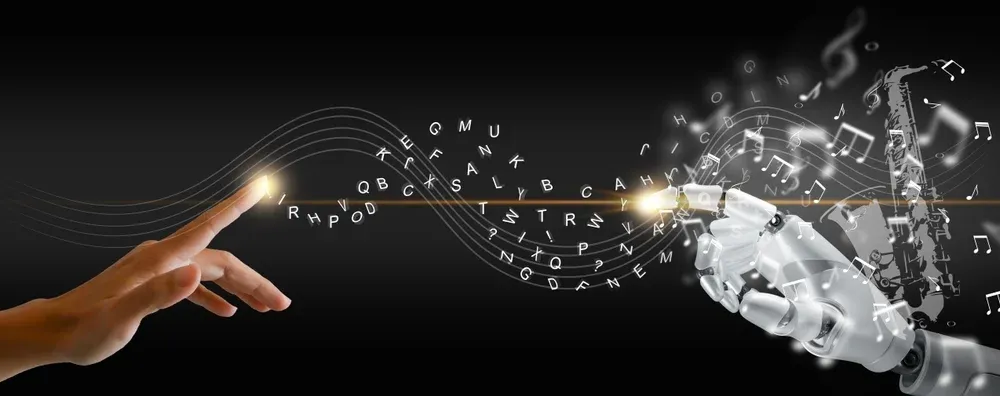
AI in music — creative collaboration of a human and a machine
So, how did AI become a part of music? It didn't happen overnight! It was a step-by-step process:
- Recommendation & Analysis: First, AI music apps like Shazam used "audio fingerprinting" to magically name that tune for you. At the same time, services like Spotify and YouTube started using smart algorithms to learn our tastes and suggest new songs we might love.
- Composition & Production: Next, AI got creative! It learned how to write its own simple melodies and even full pieces of music in the style of famous composers. Platforms like AIVA now let anyone create original songs in styles like classical, cinematic, jazz, or electronic.
- Interactive Tutoring: This all led to the amazing tools we have today. Now, AI programmes can actually "listen" to a student play an instrument through a microphone. It can analyze their pitch and rhythm in real-time and give instant, personalized feedback. This is the magic behind modern learning platforms like Yousician.
AI grew from a sci-fi idea into a patient, always-available practice buddy.
What Teachers Say about AI for Studying and Teaching
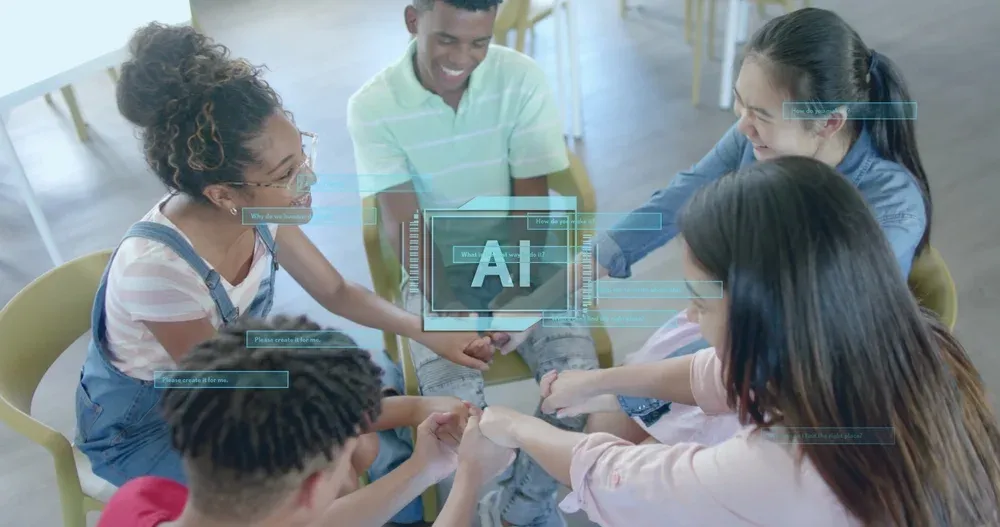
Students using AI for their studies
When it comes to AI in education, teachers are split. Many are excited to test new tools and discover how AI can save time and spark creativity. But others are deeply skeptical, asking, "Why should some algorithm tell me how to teach?". Completely understandable. Let’s see what real teachers say (from Khari Johnson’s 2025 article “Teachers Are Going All-In on Generative AI”).
AI as a Teacher’s Helper
It gives us our time and joy back.
“I'm able to spend more time with my family and my friends and my wife so I can be my best at work, instead of being tired or rundown.” — Tim Ballaret, a teacher in South Los Angeles.
It helps us create a sense of belonging.
“Just to see the joy that it brought to a family… it’s a powerful way to build connections.” — Antavis Spells, a school leader, used AI to craft a personalized song for a student in under a minute.
AI as a Cause for Concern
It can perpetuate bias and requires a human gatekeeper.
“Having a human in the loop is even more important, because it can pretty quickly generate content that is not OK to put in front of kids.” — Ian Connell, of the Charter School Growth Fund.
It lacks the human context and can be factually wrong.
“Teachers know their students. A language model does not.” — Vincent Aleven, a professor studying AI in education.
AI in the Classroom: Just a Helpful Tool, not a Replacement
The message from the classroom is clear: AI's greatest potential is realized when it amplifies, not replaces, the teacher's expertise. The overwhelming consensus — from enthusiastic adopters to cautious critics — is that the human in the loop is non-negotiable.
Early Insights on AI in Music Education
Right now, we don't have much information from music teachers who are already working in classrooms. Most of the early research has been done with future teachers who are still in training.
Their opinions give us a helpful hint about where things might be headed. However, it's important to remember that their perspective as young teachers might be different from that of current, experienced teachers.
For instance, a 2025 study published in Frontiers of Psychology of pre-service music teachers found that 96.4% regarded educational technology as beneficial — an indicator of openness to tools like AI. Even when teachers view technology positively, actual readiness to implement AI in the classroom may lag behind, though.
AI in Music Education: What it Can Do
So, what's all the excitement about AI in music education really about? It's simple: we're witnessing a fundamental shift in how we teach and learn music.
For music teachers, this is like gaining an extra pair of hands — or rather, an extra set of ears! It takes care of the technical details so you can focus on what truly matters: inspiring creativity and nurturing musical passion.
What AI Apps Can (and Can’t) Do in Music Education
✅ What AI can do
- Compose full tracks or harmonies from text prompts
- Generate backing tracks in any style or tempo
- Recreate human-like singing voices
- Offer mix or mastering suggestions
- Analyze and critique compositions
- Support music teachers with examples, lesson plans, or exercises
❌ What AI can’t do
- Feel emotion — or surprise us like a human performer can
- Create meaning beyond patterns
- Guarantee ethical use of data
- Replace a teacher’s intuition, or the bond between student and mentor
Yes, AI can do a lot. But it can't inspire your students, as you do, understand their feelings, or share in their "aha!" moments. You're in charge, AI is your helpful assistant. That's it.
AI for Music: AI Prompts Ideas for Music Teachers
Whether you're totally into tech or a little unsure about it, one thing's for sure — this stuff can be a real game-changer for saving time and making your lessons even better.
You've probably seen those AI assistants like ChatGPT, DeepSeek, and Google's Gemini floating around. Lots of teachers are using them for everyday tasks — like coming up with new lesson ideas, explaining music theory, or making worksheets.
🤩 And here's the cool part — at MOOZ we have our own AI helper designed just for music teachers. Meet MIA — MOOZ Intelligent Assistant!
MIA is your new teaching buddy who totally gets music education. While those other AI tools are pretty general, MIA actually understands what music teachers need day-to-day. MIA isn't here to replace you — you're still the rockstar teacher!
With MIA, you can:
✅ Create exercises tailored to each student's stumbling blocks
✅ Instantly generate warm-up or icebreaker ideas
✅ Generate practice routines for specific instruments in seconds
✅ Explore music theory questions with immediate, clear answers
✅ Ask about using MOOZ or get technical help
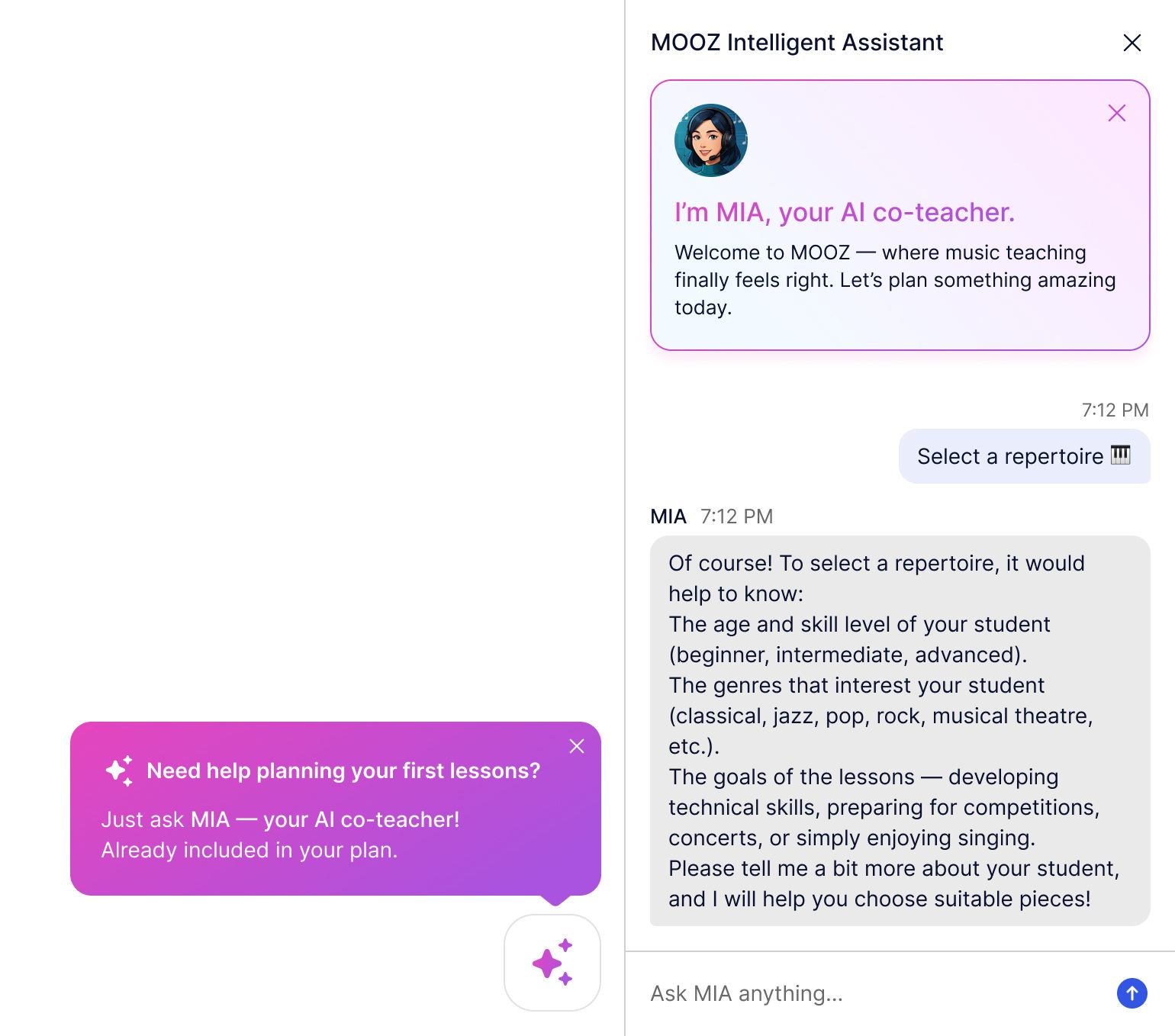
MOOZ app interface with MIA assisting a music teacher
💡 The key to success lies in a right prompt — a clear instruction that tells the AI exactly what you need.
To get you started, here are tested, classroom-ready prompts designed specifically for music teachers. Just copy, paste, and adapt them to see how quickly MIA can become your most efficient teaching aide!
Detailed Classroom-ready AI Prompts
Explaining Harmony to a Middle-School Mind
PROMPT
"MIA, Act as a friendly music teacher for middle school students. Explain the concept of harmony in simple, engaging terms. Include a short definition, an analogy, and three examples from popular songs. Create a small exercise where students clap or play chords. Conclude with a fun fact about harmony."
Creating a Quiz That Students Won’t Sleep Through
PROMPT
"MIA, Imagine you are a music teacher creating a quiz for 5th graders. Make a 10-question multiple-choice quiz about musical instruments, with four answer choices and explanations for each correct answer. Include a mix of orchestral, rock, and jazz instruments."
Designing a Custom Practice Routine
PROMPT
"MIA, Act as a personal music coach. Create a detailed, 15-minute daily practice routine for a [instrument] student at a [beginner/intermediate/advanced] level focusing on [specific skill, e.g., sight-reading, finger dexterity, breath control]. The routine should include: 1) a 3-minute warm-up, 2) a 5-minute technical exercise, 3) a 5-minute piece to work on, and 4) a 2-minute cool-down. Please provide clear, step-by-step instructions and a suggested metronome setting for each part."
Quick and Handy AI Prompts
Music Theory Simplification
PROMPT
“MIA, Create a simple, step-by-step guide for teaching rhythm patterns using clapping exercises.”
Exercise Generation
PROMPT
“MIA, Provide creative exercises to help students practice improvisation on piano in C major.”
Lesson Planning & Curriculum
PROMPT
“MIA, Suggest a progressive curriculum to teach jazz improvisation for middle school students.”
Music Analysis & Reflection
PROMPT
“MIA, Analyze the chord progression of ‘Let It Be’ by The Beatles and suggest discussion questions.”
Interactive Content
PROMPT
“MIA, Generate a list of blues improvisation challenges for small groups of piano students.”
MIA is included in all MOOZ plans. Just update your app and see how much time you can save!
The Final Note: AI as Your Partner Music Teaching
AI can handle lesson prep, generate exercises, and even give instant feedback. Yet, the human element remains the conductor of this orchestra. You are the one who guides interpretation, emotion, and nuance — the very things AI cannot replicate. With a creative collaboration with AI you can make music lessons deeper and more meaningful.
Your MOOZ AI Assistant Awaits
Pick just one prompt from above and test it in your virtual classroom this week and let MIA generate a custom warm-up routine for your next student in seconds.
Share your favorite discoveries or AI prompts with fellow teachers! We’re all learning this new piece together.

Related Articles
Synchronization in Online Music Lessons: A Complete Breakdown
Learn how tech fixes internet latency. Make synchronous music today!
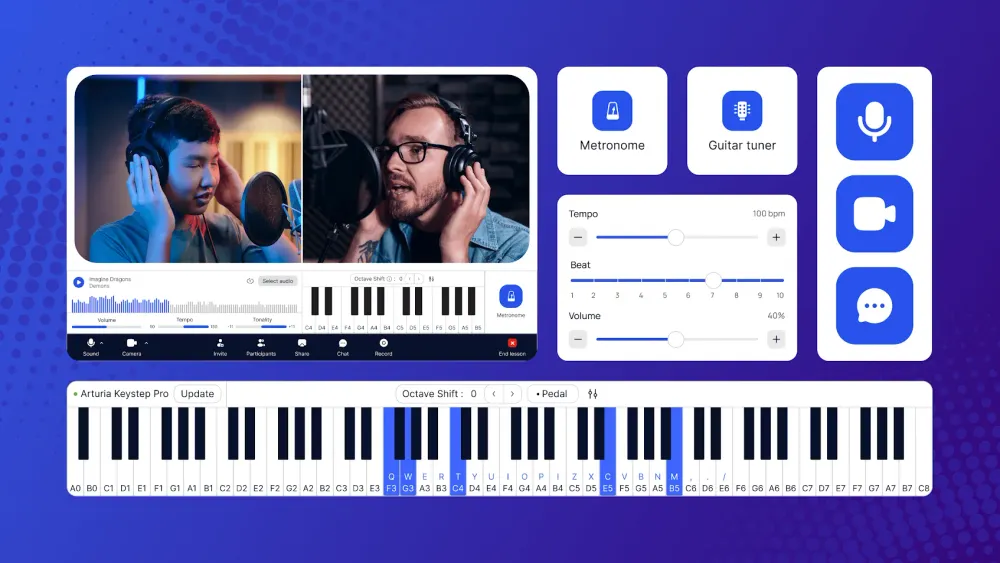
How to Start Your First Lesson in MOOZ: A Step-by-Step Guide
Read MOOZ step-by-step guide to make your first class smooth, professional, and perfectly in tune.
Guide to Teach Music Online Smarter: MOOZ & Moosiko Insights
Learn how to solve the 5 biggest online teaching challenges that are costing you time and students.