
Lesson Lab
Most singers warm up the way most people stretch before running: quickly, without much thought, and mostly in whatever way they were shown once. It usually still helps. It could help a lot more.
The useful thing to know is that vocal warm-up exercises are not one category. They do three different jobs — settling the breath, getting the vocal folds vibrating efficiently, and waking up the muscles that shape words — and doing them in the wrong order wastes most of the benefit.
Below are ten exercises, what each is actually for, and the mistake that quietly cancels it out. Then a five-minute routine, and what changes when you're warming up a whole choir.
What a warm-up is actually doing
Your vocal folds are small bands of muscle and soft tissue. Gentle use raises their temperature slightly and makes the tissue less stiff, so it vibrates with less effort. At the same time, the coordination between breath, larynx and resonance gets a rehearsal at low stakes.
That's why the rules are counter-intuitive:
- Quiet beats loud. Loud singing is the thing you're warming up for, not the warm-up.
- Middle beats high. Start where your voice is comfortable and expand outward in both directions.
- Short beats long. Five to ten minutes is plenty. Fifteen minutes of scales is practice, not preparation.
If your warm-up leaves you tired, it wasn't a warm-up.
A warm-up is quiet, boring and short — that's what makes it work
👩🎤🎵 A lip trill powered by jaw tension still sounds like a lip trill — from the inside. Get MOOZ and take your first singing lesson →.
The idea that makes half of these work
Here's the part most lists skip, and it's the reason lip trills and humming keep showing up in every method book.
When you sing through a narrowed opening — lips buzzing, mouth closed, a straw between your teeth — the vocal tract is partly blocked, and some of the sound pressure reflects back down onto the vocal folds. That back pressure helps them vibrate: they come together less forcefully, the effort drops, and the sound stays efficient.
Voice science calls these semi-occluded vocal tract exercises, or SOVT. The mechanism was laid out by Ingo Titze in the Journal of Speech, Language, and Hearing Research in 2006, and it's the closest thing vocal pedagogy has to a settled explanation for why the easy-feeling exercises work.
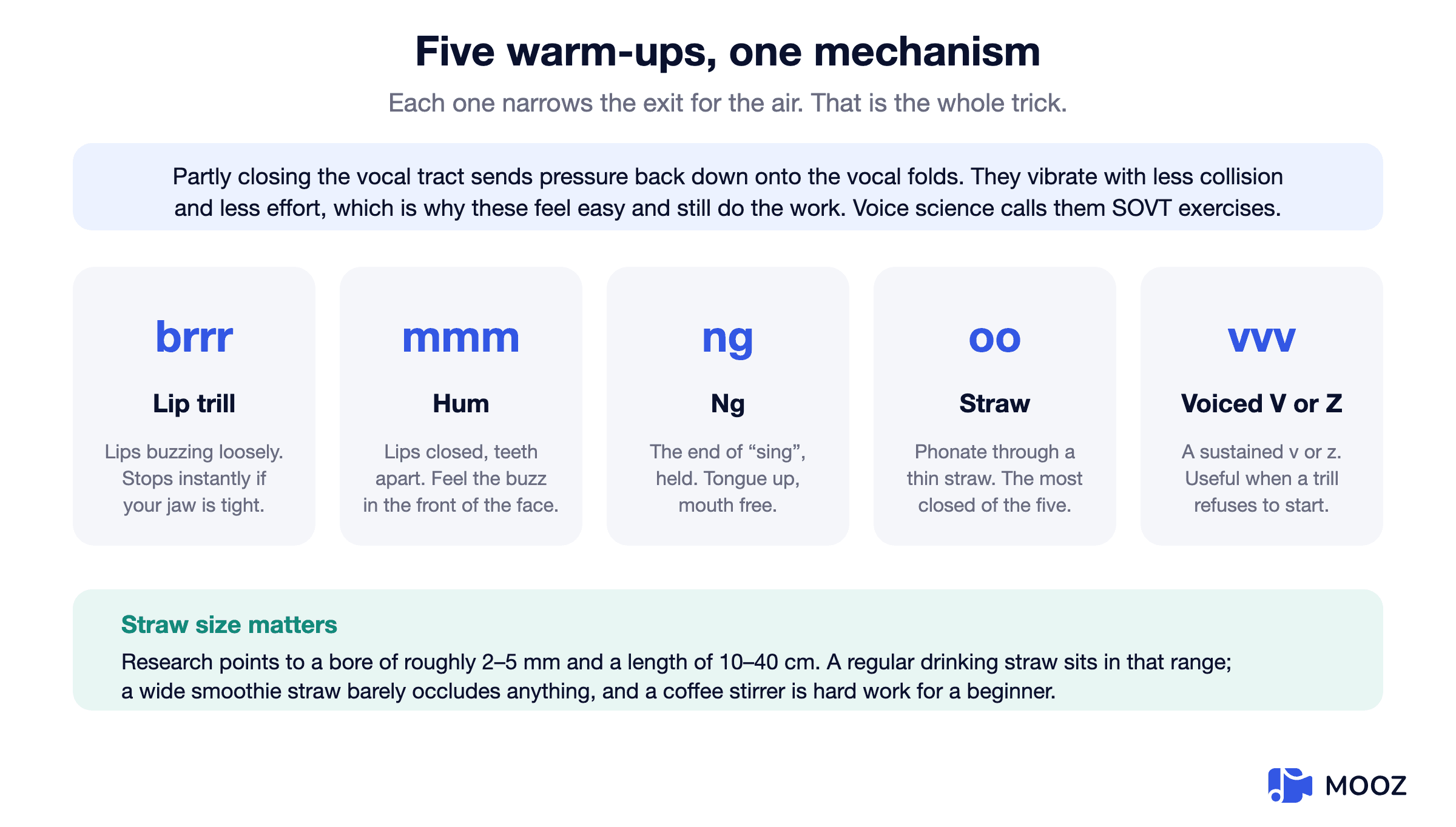
Five warm-ups, one mechanism: each narrows the exit for the air
Which means exercises 2 to 5 below are, physically, the same exercise with different amounts of closure. Pick the one your voice likes and don't feel obliged to do all four.
The 10 exercises
1. The slow hiss
What it's for: breath, before any sound is involved.
Breathe in low and quietly, then release the air on a steady sss for a count of eight. Repeat, aiming for twelve, then sixteen. The hiss should stay even from beginning to end — no fading, no push at the finish.
The mistake: taking a huge gasping breath first. Shoulders should stay put; the movement is around your lower ribs.
2. Lip trills
What it's for: the easiest SOVT exercise, and the best diagnostic in the list.
Blow air through loosely closed lips until they buzz, then add a pitch. Slide up and down a small range, then try a five-note scale.
The mistake: forcing it when it won't start. A trill that keeps stalling is telling you the jaw is tight or the breath is uneven — that's information, not failure. Rest a finger on each cheek to help it along, or switch to exercise 3.
3. Humming on M
What it's for: the same benefit as a lip trill, with nothing to go wrong.
Lips together, teeth apart, jaw loose. Hum a comfortable note and look for a buzzing feeling around the lips and nose. Slide up a third and back down.
The mistake: clenching the teeth. If your molars are touching, the hum tightens immediately. If a hum feels dead, try a sustained v or z instead — same family, slightly more airflow.
4. The "ng"
What it's for: finding resonance without the mouth getting involved.
Say "sing" and hold the final consonant. The tongue seals the back of the mouth, the sound moves forward, and there's very little you can do wrong. Glide up and down on it.
The mistake: letting it become a nasal whine. It should feel buzzy and easy, not pinched.
5. Straw phonation
What it's for: the most closed of the SOVT family, and the one with the most research behind it.
Hum a note through a drinking straw. Slide gently up and down; you'll feel the vibration back in your throat rather than your mouth. Two or three minutes is plenty.
The mistake: the wrong straw. Research points to a bore of roughly 2 to 5 mm — a standard drinking straw. A wide smoothie straw barely occludes anything, and a coffee stirrer makes it hard work.
6. Sirens
What it's for: connecting your registers so the gear change stops being a crack.
On a hum or lip trill, slide slowly from the bottom of your comfortable range to the top and back, like a slow ambulance. No stopping at pretty notes.
The mistake: speed. Fast sirens skate over the exact spot in the middle where your voice changes gear, which is the spot you're trying to smooth out.
7. The yawn-sigh
What it's for: releasing the throat after everything above has tightened it slightly.
Start a yawn, and at the top of it let a sigh fall from a high note to a low one on an open ah. It should sound like relief, not like singing.
The mistake: treating it as an exercise to perform. It is deliberately unmusical.
8. Five-note scales on vowels
What it's for: the first exercise with your mouth actually open. This is where warm-up starts becoming singing.
Sing up and back down five notes — do re mi fa sol fa mi re do — on one vowel. Move up a semitone and repeat, then come back down through the starting key. Use ee, ay, ah, oh, oo on different passes.
The mistake: chasing your top note. Go up until it stops being comfortable, then come back down. The bottom of your range needs the same attention and rarely gets it.
9. The vowel ladder
What it's for: keeping the tone consistent while the mouth changes shape.
On one comfortable note, move through ee — eh — ah — oh — oo without breaking the sound. The aim is that a listener hears one steady tone with the vowels changing on top, not five different voices.
The mistake: letting the jaw do the work. The tongue and lips shape vowels; the jaw mostly stays where it is.
10. Consonants and tongue twisters
What it's for: the articulators, which are the last thing to wake up and the first thing an audience notices.
Repeat ba-da-ga, mi-me-ma-mo-mu, or any tongue twister, slowly at first, then faster. Say them, then sing them on one pitch.
The mistake: doing this first. Articulation work is fine when cold, but it does nothing for the folds, so it belongs at the end rather than the beginning.
A five-minute vocal warm-up
Most days you don't need all ten. Here's the order that gets the most out of a short window.
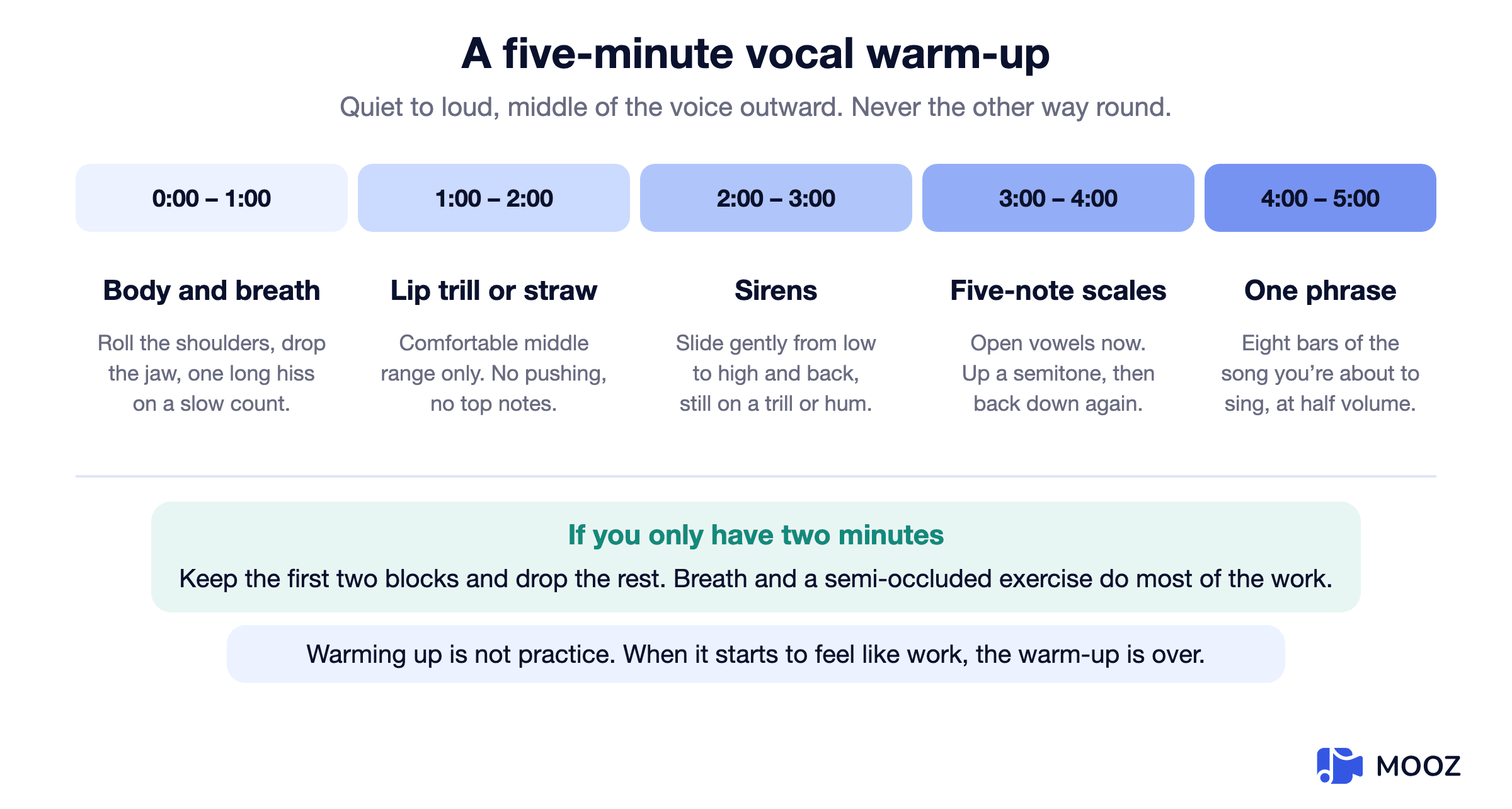
A five-minute vocal warm-up, minute by minute
🎤🧱 This is a generic routine. Yours should be built around where your break sits, which exercises your voice starts easily on, and what you're about to sing. Get MOOZ and take your first singing lesson →.
The sequence matters more than the contents: breath, then something semi-occluded, then range, then open vowels, then a phrase of real music. Every step is slightly more demanding than the one before, and none of them is loud.
Choir warm-ups
Warming up a group has a second job on top of the first: turning a room of individuals into one instrument. A few things change.
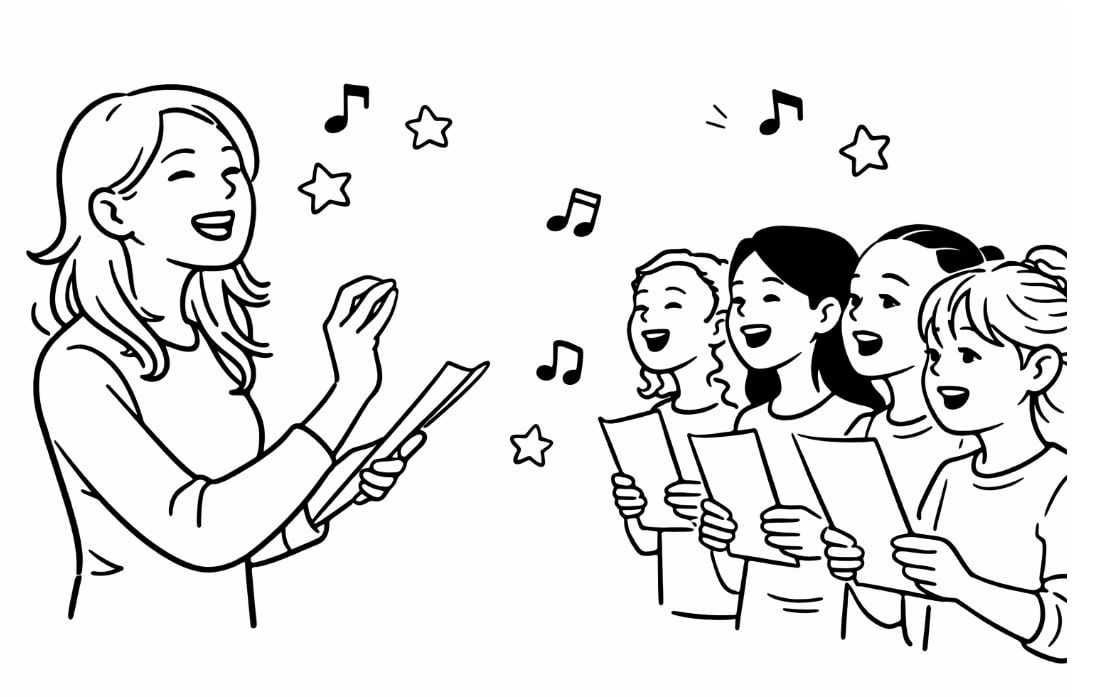
Choir warm-ups have a second job: getting a room of voices to agree
- Start physical. Shoulder rolls, a shake-out, a stretch. Half a choir arrives having sat in a car for forty minutes.
- Use unison before harmony. A hum or an ng on a single pitch tells everyone, immediately, whether the room is in tune.
- Warm up quietly. In a group there's social pressure to sing out, and the enthusiastic third of any choir will over-sing the warm-up if you let them.
- Watch the range. A warm-up pitched for the sopranos leaves the basses grinding at the top of their comfortable range. Move by semitone and turn around early.
- Finish with a round. A canon or a simple round does tuning, listening and blend at once, and it's the only part anyone enjoys.
Ten minutes is a normal choir warm-up. Twenty is rehearsal time you won't get back.
Cooling down
Almost nobody does this, and it takes ninety seconds. After a heavy rehearsal or a gig, a couple of minutes of gentle humming or straw work in your middle range brings the voice back toward speaking. Singers who cool down tend to report an easier voice the next morning.
Five mistakes that make warm-ups useless
- Starting loud. The first sound of the day shouldn't be a full-voice note. Ever.
- Going for the top note early. High notes come at the end of the warm-up, not the start.
- Same routine regardless. Warming up for a quiet ballad and for two hours of belting are different jobs.
- Skipping it when tired. That's precisely when the voice needs the easy start.
- Clearing your throat. It slams the folds together. Swallow, sip water, or hum instead.
When not to sing at all
A warm-up is not a fix for a voice that's already hurt. Sharp pain, a voice that drops out mid-phrase, or hoarseness lasting more than two weeks are reasons to stop and see a doctor rather than push through with exercises. Everything on this page assumes a healthy voice.
FAQ: vocal warm-up exercises
How long should a vocal warm-up be?
Five to ten minutes for most singers, and ten to fifteen before a demanding performance. Longer than that starts eating into the voice you were saving.
What is the single best vocal warm-up?
If you only do one, make it a semi-occluded exercise — a lip trill, a hum or a straw — through a gentle slide. It gets the folds vibrating efficiently with the least possible strain.
Do I need to warm up before every practice?
Before singing, yes, even briefly. Two minutes of humming before a practice session is enough. The full routine is for performances and long rehearsals.
Can warm-ups increase my range?
Not directly, but they let you use the range you already have. Notes that feel impossible cold are often available ten minutes later. Real range growth comes from technique over months.
Are lip trills better than humming?
No — they're the same mechanism with slightly different amounts of closure. Use whichever one your voice starts easily on, and switch if it stops working.
What are good choir warm-ups?
Physical stretches, unison humming to check tuning, an ng glide, five-note scales moving by semitone, and a round to finish. Keep the volume down and the range central.
Should I warm up before speaking, not singing?
It helps a lot before a presentation, a long teaching day or anything requiring hours of talking. The same SOVT exercises work; you just need fewer of them.
Getting your warm-up checked once
Warm-ups are self-serve, but they're also easy to do subtly wrong for years: a lip trill powered by jaw tension, a siren that skips the register change, a hum that's actually pinched. None of that is audible from the inside.
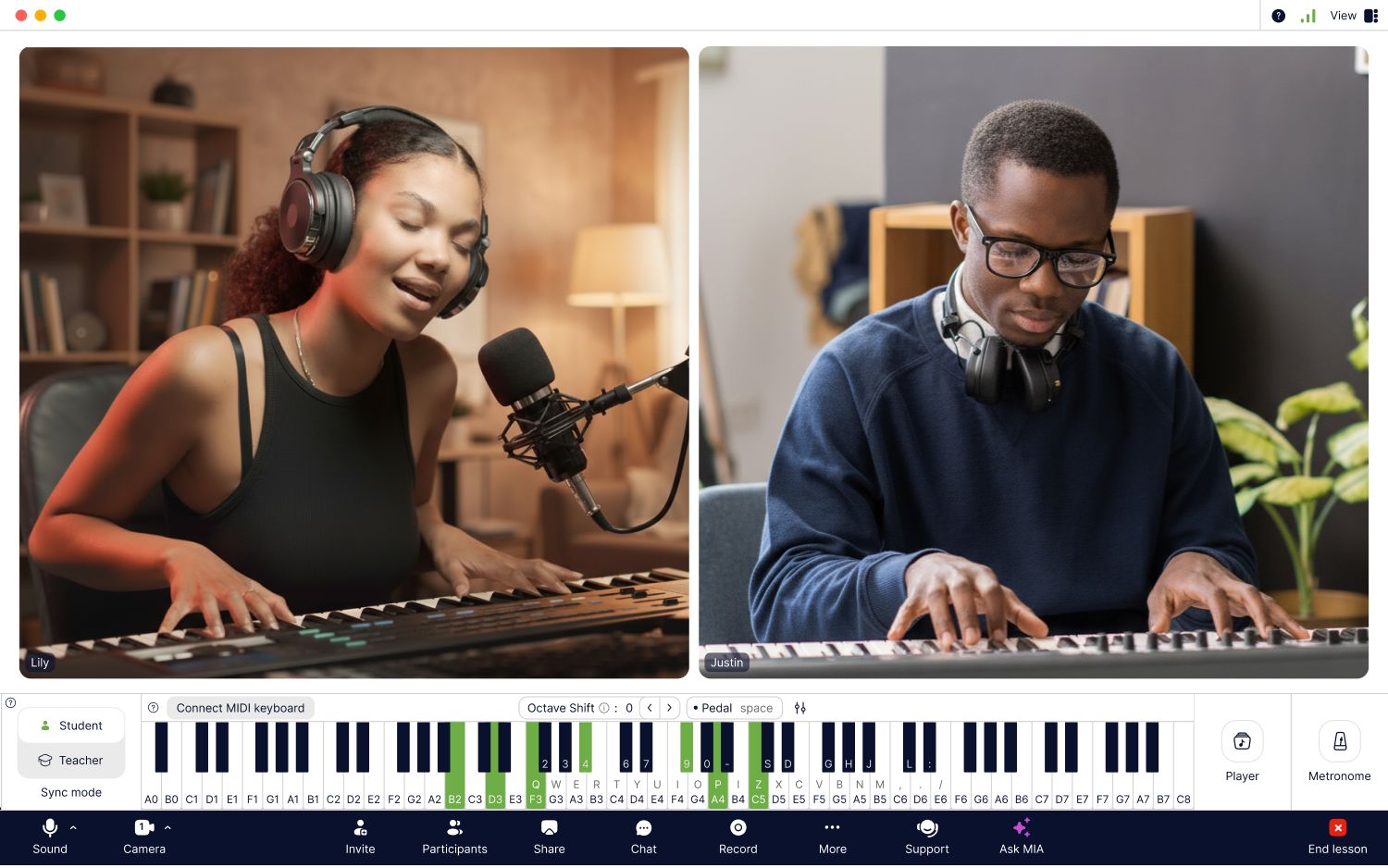
A live vocal lesson on MOOZ, where the teacher hears your actual tone
One lesson is usually enough to sort out the whole routine. You can get MOOZ and take your first singing lesson.
Lessons run in a platform built for music rather than a general video call, which matters here more than it looks: ordinary calls treat quiet breathy sounds as background noise and cut them, and quiet breathy sounds are exactly what a warm-up is made of. Your teacher hears the wobble at the start of a note, the air escaping on a high phrase, the tension you can't hear yourself — and can transpose an exercise into your range, or record the lesson so you have the right version to practise with during the week.
For what happens after the warm-up — what beginner lessons actually train, and how long progress takes — we wrote that up in singing lessons for beginners and adults.
Sources
- Ingo R. Titze, "Voice Training and Therapy With a Semi-Occluded Vocal Tract: Rationale and Scientific Underpinnings," Journal of Speech, Language, and Hearing Research 49, no. 2 (2006): 448–459.
- Straw dimensions reflect the range reported across published straw-phonation studies: roughly 2–5 mm bore, 10–40 cm length.
Related Articles

Synchronization in Online Music Lessons: A Complete Breakdown
Learn how tech fixes internet latency. Make synchronous music today!

Why Online Music Schools Lose 35% of Students
Discover how music schools can reach 15–20% higher student retention.
Online vs In-Person Guitar Lessons: Pros and Cons
Compare online and in-person guitar lessons to find the best way to learn guitar. Learn costs, pros and cons, and how to choose the right format for fast progress.